



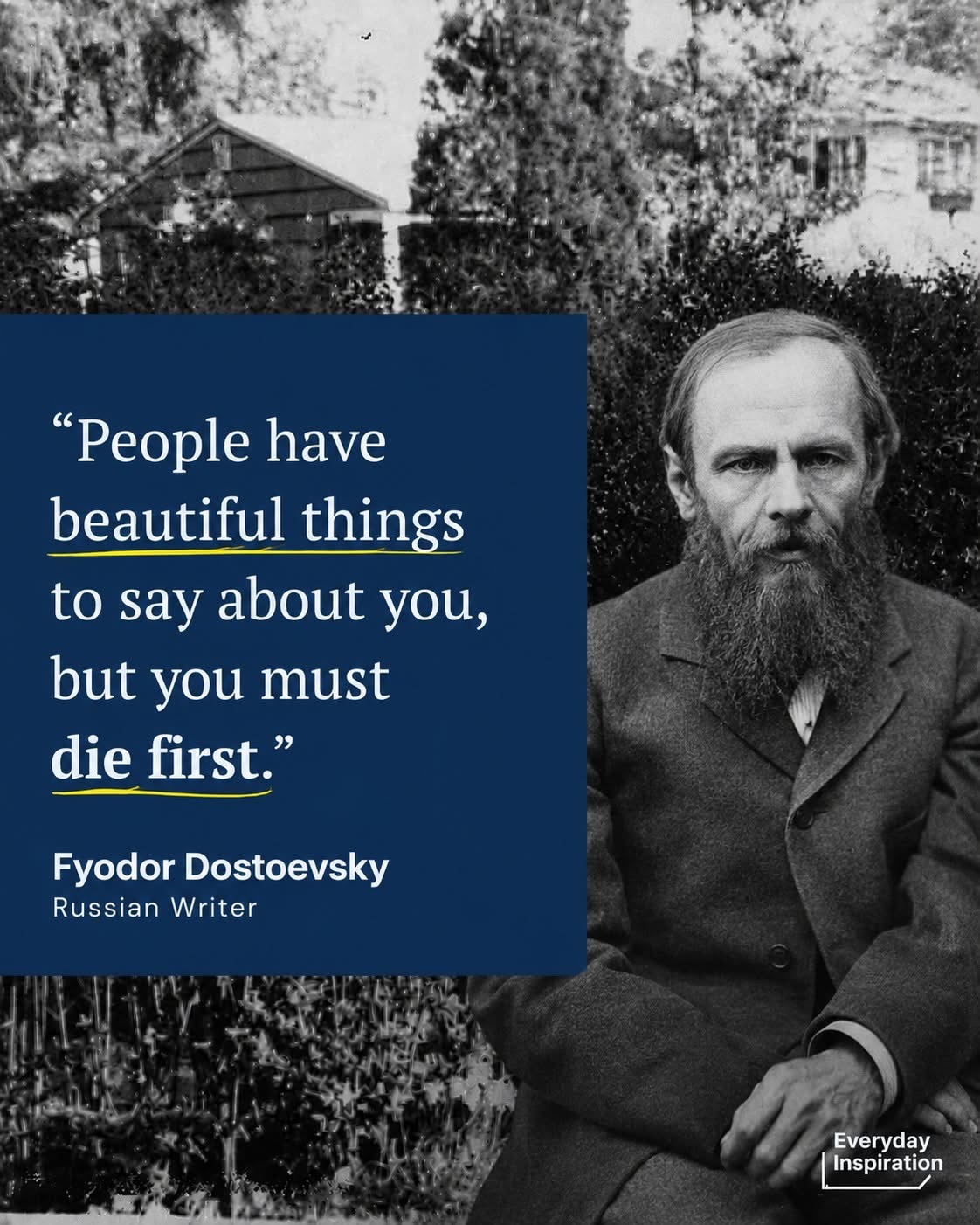
In 1849, a young Fyodor Dostoevsky stood blindfolded before a firing squad, convinced he had only moments left to live. He heard the commands. He felt the cold. He made his peace with the end.
Then, at the last possible second, a stay of execution arrived.
His death sentence was commuted to years of hard labor in Siberia. That brush with mortality did not break him — it transformed him. And from that frozen prison camp, Dostoevsky emerged with one of the most uncomfortable truths about human nature ever written.
The recognition paradox
“People have beautiful things to say about you,” the Russian novelist observed, “but you must die first.”
It is a line that stings because it rings true. Funeral gatherings are filled with eloquence. Gravesides overflow with tributes. Obituaries glow with accomplishments that somehow never found their way into performance reviews or dinner table conversations while the person was still breathing.
Why?
Dostoevsky believed the answer lay in ego. While you are alive, your presence is an unconscious threat to the status of others. Your success forces them to measure their own. Your talent casts a shadow. Your very existence becomes a mirror they did not ask to look into.
So they hesitate. They wait. They save their applause for a stage you will never hear.
The safety of the grave
Once you are gone, something shifts. The threat evaporates. The living are no longer competing with you — they are remembering you. And in that remembering, they find a gift: the chance to perform their own virtue by celebrating yours.
“Look how much we loved him,” they say. “Look how much she meant to us.”
None of it is false. But all of it is late.
Dostoevsky understood that social recognition is often delayed not by malice, but by the quiet, unspoken calculus of human insecurity. To praise someone openly while they live is to admit, even if briefly, that someone else has something you do not. To praise them after death costs nothing — and buys everything.
A call to break the cycle
The novelist’s insight was not meant to embitter. It was meant to awaken.
If the world is slow to speak while you live, then you must not wait for the world. Speak now. Thank now. Acknowledge now.
Write the letter. Make the call. Post the tribute while the person can still read it. Say “I am proud of you” before the eulogy. Say “I love you” before the obituary.
Dostoevsky spent years in Siberian labor camps, but he never forgot what it felt like to believe his last moment had come. That awareness made him ruthless about one thing: he refused to save his words for the dead.
Your words today are the only ones that matter
The dead do not read eulogies. They do not hear the standing ovation. They do not feel the warm embrace of a tribute written in past tense.
But the living do.
So here is the question Dostoevsky leaves for every reader, every leader, every parent, every friend, every Ghanaian who has ever whispered “Rest in peace” while wishing they had spoken while there was still time:
What beautiful thing are you waiting to say? And who are you waiting to say it about?
Because the firing squad does not send a reminder. The stay of execution does not always come. And the words you save for the grave will never reach the ears they were meant for.
Say it now.
— MyJoyOnline Feature


