



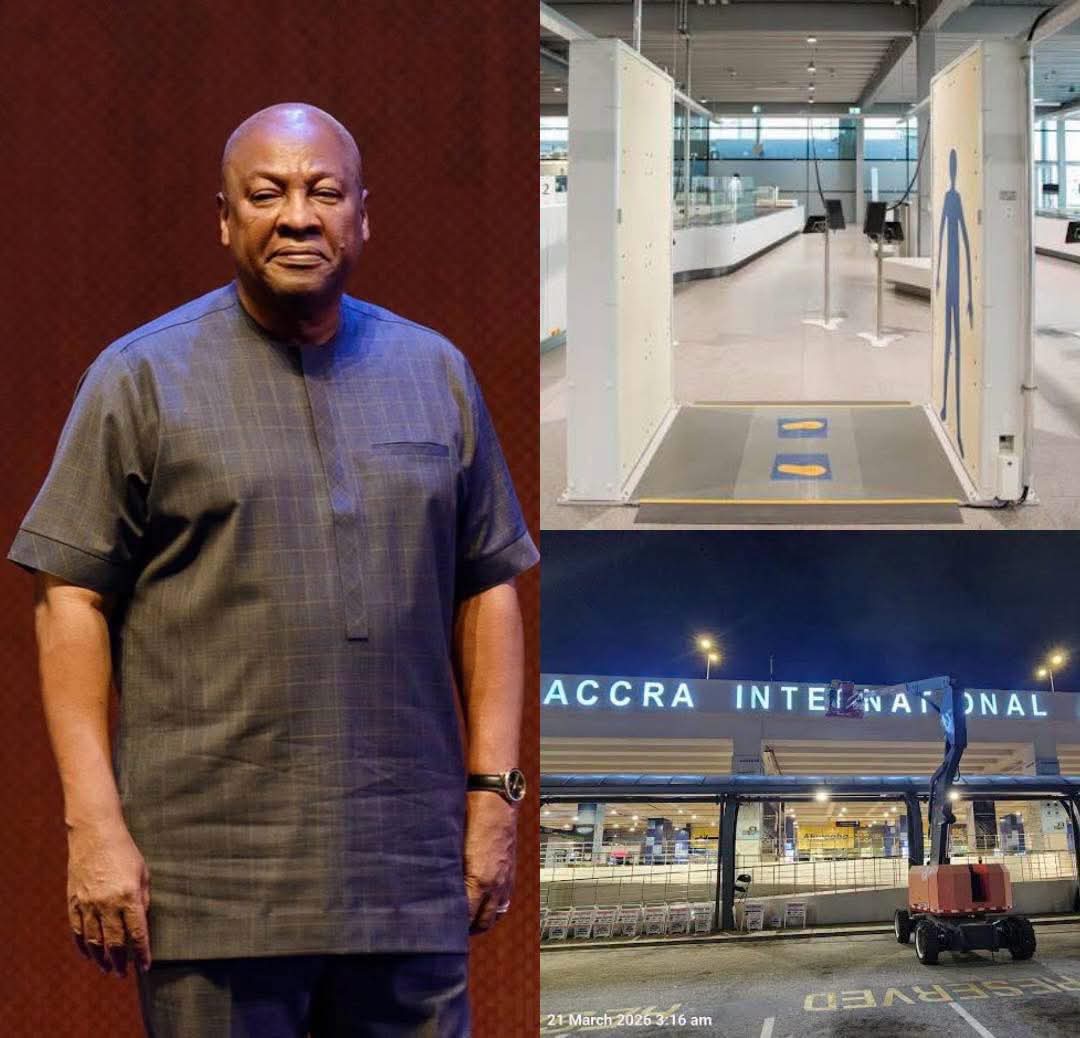
Mahama Unveils “Seamless Travel” Initiative: New Scanners at Kotoka Airport to End Laptop and Shoe Removal
ACCRA – In a major move to modernize Ghana’s aviation sector, President John Dramani Mahama has announced that new advanced 3D scanning technology will be installed at Terminals 2 and 3 of the Kotoka International Airport (KIA), effectively ending the tedious ritual of removing laptops, liquids, shoes, and belts during security checks.
The President revealed the reforms during the launch of Ghana’s new e-Visa system, highlighting a strategic shift toward “intelligence-led” screening designed to slash congestion and wait times.
“New 3D scanners are being installed in both Terminal 3 and Terminal 2. These scanners will eliminate the need to remove laptops and liquids from your baggage when you travel,” President Mahama stated. He further assured travelers that by August 2026, additional equipment will be deployed to remove the inconvenience of having to take off shoes and belts.
Efficiency Without Compromising Security
According to the Ghana Airports Company Limited (GACL), which is spearheading the $800 million infrastructure modernization program, the new scanners use advanced analog technology to create high-resolution 3D images of baggage contents. This allows security personnel to zoom in and rotate images for thorough inspection without forcing passengers to unpack their belongings.
“The objective is to enhance the passenger experience. We are in 2026, and we need to ensure that even as we secure our borders, the process is seamless,” a GACL official had noted during the 5th Aviation Ghana Breakfast Meeting earlier this year.
The system will be integrated with Ghana’s Advanced Passenger Information (API) and Passenger Name Record (PNR) frameworks, linking screening data directly with international watchlists to strengthen border security.
A Contrast in Technological Competence
The announcement has been met with enthusiasm from the traveling public and business communities, who view it as a practical solution to a chronic pain point. However, the President’s remarks also carried a pointed critique of the previous administration’s legacy on tech infrastructure.
President Mahama contrasted his administration’s practical upgrades with what he described as the embarrassing failures of the former government’s flagship “E-Gate” project. The reference drew sharp memories of a 2024 incident where former Vice President Dr. Mahamudu Bawumia experienced a public malfunction of an electronic gate during its commissioning.
Critics of the previous administration have pointed to the lack of transparency surrounding the E-Gate project. Parliament was recently informed that there was reportedly “no formal contract” signed for the controversial $240 million system, leading to questions about the viability of projects rushed for political capital.
“This is the kind of development Ghanaians want to see—focused on building and modernizing the country with practical solutions that improve everyday life. Not like those who claimed to be ‘technology people’ but introduced an electronic gate that couldn’t even open for themselves,” a source close to the presidency stated, echoing the President’s sentiment.
Broader Aviation Ambitions
The scanner installation is part of a sweeping transformation of the Accra International Airport. Beyond security, the government is constructing an interconnecting concourse to link Terminals 2 and 3, featuring five new passenger boarding bridges, modern waiting areas, and premium lounges.
Additionally, plans are underway for a seven-storey, 2,000-car multi-storey car park and a dual-concept airport hotel—offering both budget (“Mbobrɔwa”) and luxury accommodations.
As construction progresses, travelers flying through Accra can expect a world-class experience by August, where keeping their shoes on and laptops in their bags will become the new standard.


