



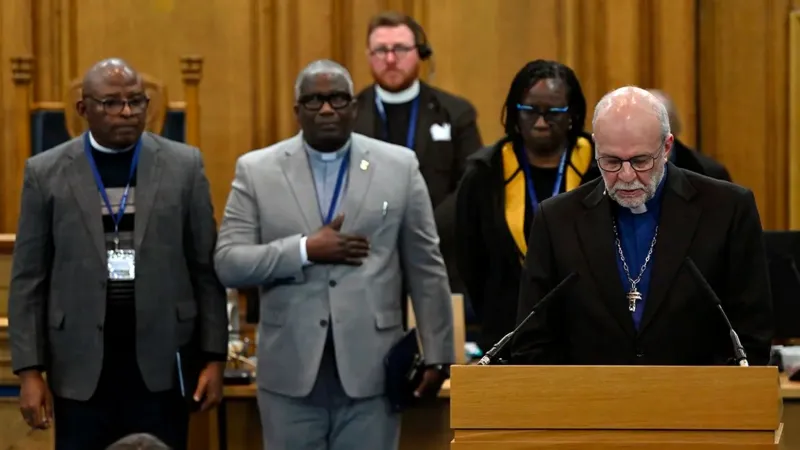
The Church of Scotland has issued a formal apology for its historical involvement in slavery, acknowledging that some of its members once provided theological justifications for chattel slavery.
The apology was adopted at the church’s General Assembly in Edinburgh on Saturday, marking a significant moment of reckoning with the institution’s past.
Before the abolition of slavery in the British Empire in the 1830s, certain members of the Kirk actively defended the practice on theological grounds. The church has now recognised that historically, some of its members benefited from both direct and indirect participation in the slave trade.
“Grieved beyond telling”
The formal apology states that the Kirk is “grieved beyond telling by the extraordinary suffering we have inflicted – through our actions and our inaction – on our brothers and sisters.”
It continues: “We repent, committing ourselves to changing course and bearing fruit worthy of repentance.”
The Very Rev Sally Foster-Fulton, who presented the apology to the General Assembly, said: “The history we consider today continues to shape our world in ways we cannot ignore.
“Its consequences touch communities near and far, influencing the structures, attitudes and inequalities that persist around us. The legacy of slavery stretches like a shadow over our local, national and global landscape. Naming that is not about blame, but about faithfulness – about recognising that healing begins where truth is spoken.”
International response
Rose Wedderburn, general secretary of the United Church in Jamaica and the Cayman Islands, praised the move.
“While the process has understandably evoked deep emotions – the effort invested in truth-telling and honest engagement is worthwhile,” she said.
The apology was read by the Rt Rev Gordon Kennedy, Moderator of the General Assembly, who was joined by delegates from Nigeria, Ghana and Jamaica.
Growing reckoning in Scotland
The Church of Scotland joins a number of Scottish institutions that have apologised for historical links with slavery. Both Edinburgh and Glasgow city councils issued similar apologies in 2022.
The development raises renewed questions about whether Scotland needs a dedicated museum of slavery to address this chapter of its history.
The Kirk has previously established a £100 million fund to “address slavery wrongs,” though some critics have suggested the fund is insufficient to right historical injustices.


