



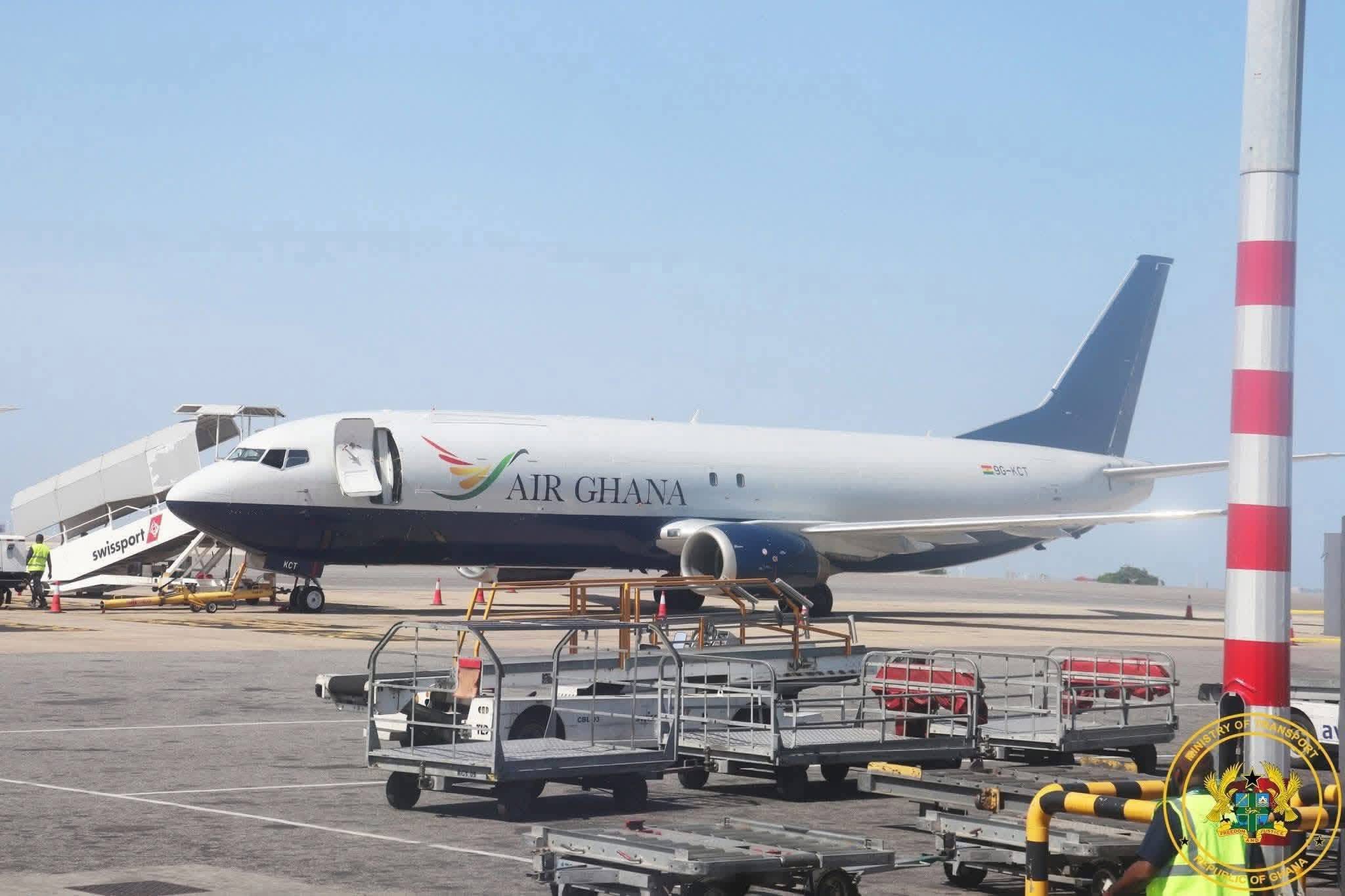
A dedicated Boeing 737-400 freighter operated by Air Ghana has arrived at Kotoka International Airport, marking an operational upgrade to the country’s air cargo logistics network.
The aircraft is expected to enhance cargo connectivity between Ghana and other countries, enabling faster and more efficient transportation of goods. While the asset is a private sector investment, the Ministry of Transport has welcomed the development as a sign of growing confidence in Ghana’s aviation and trade infrastructure.
The arrival comes as the administration of President John Dramani Mahama points to a series of verifiable infrastructure milestones, urging stakeholders to balance oversight with acknowledgment of tangible progress.
Infrastructure Delivery Under the NDC Government
Since assuming office following the 2024 election, the National Democratic Congress (NDC) government has rolled out several major projects:
· Road Contracts: Over 2,000 kilometres of roads have been contracted between 2025 and 2026, with an estimated value of GHS 50 billion. This includes the Eastern Corridor’s Chereponi–Bunkpurugu road, which is scheduled to commence construction shortly.
· Accelerated Execution: In the Eastern Region, the 32-kilometre Akosombo–Gyakiti–Kudikope road is already 40 per cent complete after only five months of work. The contractor has reportedly progressed ahead of schedule without having received payment—a development President Mahama personally inspected last week.
· 24-Hour Economy Financing: The government has unveiled a US$4.1 billion financing framework to fund its flagship 24-Hour Economy policy. The model relies on domestic resources, including pension funds and diaspora bonds, rather than external borrowing from the IMF or World Bank.
Corporate and Investor Sentiment
Industry observers note a steady uptick in business activity.
“Many companies are investing, expanding and doing business here,” a trade analyst commented. “Instead of excessive criticism, it is in the national interest to acknowledge measurable achievements and work collaboratively to build on them.”
The NDC government has encouraged what it calls “responsible accountability”—criticism grounded in facts, coupled with recognition of delivery where evidence exists.
Conclusion
With air cargo capacity rising, road networks expanding, and a novel self-reliant economic framework taking shape, the Mahama administration maintains it is serious about delivering on its campaign pledges.
For now, the government’s message to the public and business community remains captured in its popular slogan: JM Toaso! — urging continuous, forward momentum.


