



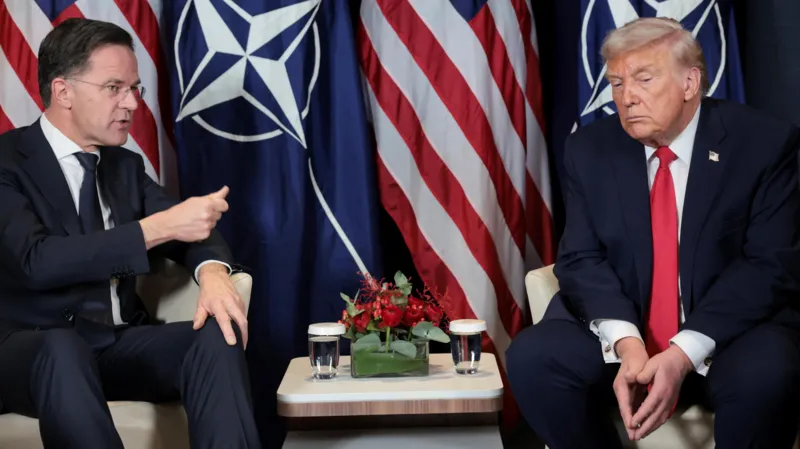
President Donald Trump sharply criticized NATO for failing to support the United States in the ongoing war with Iran, hours after a private White House meeting with alliance chief Mark Rutte that the secretary general described as “very frank and very open.”
In a post on Truth Social following the Wednesday meeting, Trump wrote: “NATO WASN’T THERE WHEN WE NEEDED THEM, AND THEY WON’T BE THERE IF WE NEED THEM AGAIN.”
The remarks marked the latest in a series of threats by the president to withdraw from the 32-member transatlantic alliance, which he has accused of abandoning American interests during Operation Epic Fury.
White House Press Secretary Karoline Leavitt said Wednesday that NATO had been “tested and they failed,” adding that member countries “turned their backs on the American people,” who fund their nations’ defense.
Rutte, however, offered a more measured account of the talks, telling CNN that he pointed out to Trump that “the large majority of European nations has been helpful with basing, with logistics, with overflights.”
“It’s therefore a nuanced picture,” Rutte said.
The secretary general was at the White House for more than two hours, though the duration of his face-to-face meeting with Trump remains unclear. The sit-down was seen as an urgent effort to convince the president that remaining in NATO serves U.S. interests, particularly as tensions with Iran escalate.
Trump has in recent weeks threatened to pull the U.S. out of the alliance after several NATO countries resisted his calls to help reopen the Strait of Hormuz, a move aimed at easing rising global oil prices.
Rutte told CNN that NATO members do not view the war in Iran as illegal and that most agreed it was important to degrade Iran’s nuclear capabilities. He credited Trump’s “leadership” for making the world “absolutely” safer than before the conflict.
The president also used his Truth Social post to air another grievance, writing: “REMEMBER GREENLAND, THAT BIG, POORLY RUN, PIECE OF ICE!!!”
Under U.S. law passed by Congress at the end of 2023, a president cannot unilaterally withdraw from NATO without the approval of a two-thirds Senate majority or an act of Congress.
Whether Rutte’s personal rapport with Trump and the argument that European nations have provided significant support will be enough to keep the U.S. in the alliance remains an open question. The dispute has created what analysts describe as perhaps the greatest challenge NATO has faced in its history.


