



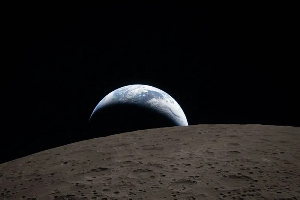
NASA has unveiled the first images captured during the Artemis II mission’s lunar flyby, offering the closest views of the Moon’s surface from a crewed spacecraft in more than five decades.
The images, transmitted from the Orion spacecraft, show the Moon’s rugged, cratered terrain in stunning detail—along with a distant shot of Earth appearing as a small blue sphere against the blackness of deep space.
Artemis II, which launched last week, marks the first time since the Apollo era that humans have traveled beyond low-Earth orbit. The four-member crew is currently testing Orion’s systems during a lunar flyby before returning to Earth. Unlike future missions, Artemis II will not land on the Moon.
The newly released photos were taken during a critical phase of the journey when Orion performed a close pass of the lunar surface. For approximately 34 minutes, the spacecraft passed behind the Moon, causing a temporary communications blackout—a planned event that left mission controllers in Houston waiting in suspense.
Once contact was restored, the crew downlinked a series of high-resolution images. One particularly striking frame captures the Moon’s shadowed south pole, a region scientists believe holds water ice and is a target for future landings. Another shows the Orion spacecraft’s solar array with the crescent Earth in the distance.
“These images are more than just beautiful,” said NASA Administrator Bill Nelson in a statement. “They are proof that our systems are working, and they remind the world why we explore—to push further, see farther, and bring humanity along.”
The Artemis II mission is the first crewed test flight of NASA’s Artemis program, which aims to return astronauts to the lunar surface by the end of the decade and eventually establish a long-term presence there. A successful Artemis II will pave the way for Artemis III, which will land the first woman and first person of color on the Moon.
The crew—commander Reid Wiseman, pilot Victor Glover, mission specialist Christina Koch, and Canadian astronaut Jeremy Hansen—has been documenting the journey with onboard cameras. In addition to public outreach, the imagery will help engineers assess how Orion performs in the deep-space environment.
For space enthusiasts, the images evoke iconic photos from Apollo missions of the 1960s and 1970s. But NASA officials stress that Artemis is not a repeat of the past—it is a stepping stone to Mars.
“The Moon is a proving ground,” said mission control commentator Sandra Jones during a live broadcast. “What we learn here, we take to Mars.”
The Artemis II flyby continues, with splashdown in the Pacific Ocean scheduled for later this month. Meanwhile, the newly released images are already circulating widely online, drawing comparisons to Earthrise—the historic Apollo 8 photograph that changed humanity’s view of its home planet.
NASA has promised additional imagery and video in the coming days as the mission progresses.


