



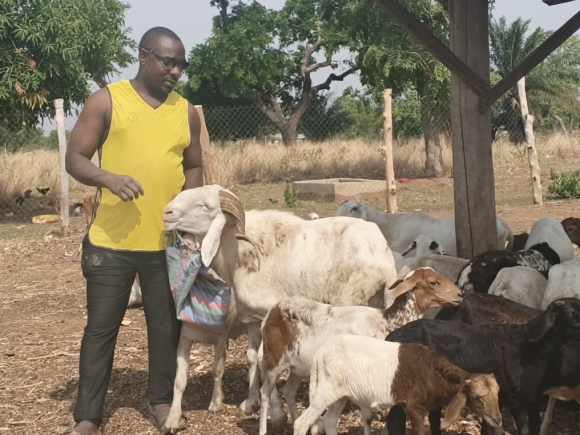
A farmer in northern Ghana is proving that smart agricultural practices—using improved pasture, better livestock breeds, and natural pest control—can boost productivity, create wealth, and ease tensions between crop farmers and herders.
Mohammed Awal, a laboratory scientist turned livestock farmer, founded Premium Pasture Animal Farm in Kpandai. His approach is built on a simple yet transformative idea: growing cultivated pasture to feed animals year-round.
For generations, livestock farmers across Ghana’s savannah belt have relied on natural grazing. But this system fails during the long dry season (November to April), when bushfires and harsh weather destroy available forage.
“I grow my own grass to feed my animals because during the dry season, there is no green grass due to bushfires. Animals suffer a lot,” says Awal, who experienced these challenges firsthand as both a herdsman and farmer.
A Sustainable Livestock Model
To ensure reliable feed, Awal imported improved pasture species from India, Kenya, and Thailand—including modified Napier grass, Brachiaria grass, and Mucuna. These varieties are highly nutritious and drought-resistant.
In just three years, his farm has grown from 10 animals to over 100 sheep and goats. He has also introduced superior breeding stock: South Africa’s Savannah goat and the long-legged “Balibali” sheep from Niger. These breeds are more muscular and productive, ideal for crossbreeding with local stock to increase meat yield and herd quality.
A Natural Cure for a Costly Problem
Ticks had been a major challenge, forcing heavy reliance on chemical treatments. Awal’s solution: introducing guinea fowls, which feed on ticks found on animals and around the farm.
“For the past two years we have not recorded any major tick problems on the farm,” he says. This innovation has nearly eliminated chemical use, reduced veterinary costs, improved animal health, and provided an additional income source—all while being environmentally friendly.
Reducing Farmer-Herder Conflict
Traditional open grazing often leads to conflict when livestock stray into crop fields. Awal’s semi-intensive model—growing his own pasture and confining animals—drastically reduces that risk. Agricultural experts believe such innovations could help resolve long-standing disputes across northern Ghana and West Africa.
Creating Wealth Through Integration
On his 20-acre farm, Awal also cultivates yams, cassava, sweet potatoes, and maize to support animal feed and diversify income. Remarkably, even the grass itself has become a revenue source.
“Growing grass alone is generating income for me apart from the sale of animals and crops,” he notes.
Nutrition, Food Security, and Climate Benefits
By improving livestock productivity and quality, Awal contributes to more nutritious food in local markets. His methods are also climate-smart: Brachiaria grass improves soil fertility, prevents erosion, sequesters carbon, and tolerates drought. Reducing open grazing also prevents land degradation.
Challenges to Expansion
Despite success, Awal faces obstacles: dry-season water shortages (despite rainwater harvesting), limited capital, bushfire risks, lack of mechanization, and difficulty finding trained caretakers. Access to affordable credit remains a major barrier.
Opportunities for Youth and Retirees
Awal believes his farm could serve as a training model for Ghanaian livestock farmers. “This type of farming is flexible and can help retirees improve their livelihoods,” he says. He also encourages young people to see livestock farming as a business: “My farm is open for partnerships. I encourage the youth to team up and venture into livestock farming because it is lucrative.”
A Model for the Future
Experts see farms like Premium Pasture Animal Farm as the future of livestock production in Ghana—offering solutions to climate change, population pressure, and land scarcity. With better access to credit, water infrastructure, and training, such models could reduce poverty, strengthen food security, and promote peaceful coexistence.
For Mohammed Awal, the vision is clear: transform livestock farming into a modern, profitable, and environmentally sustainable enterprise. On his 20-acre farm, that vision is already taking root.


