


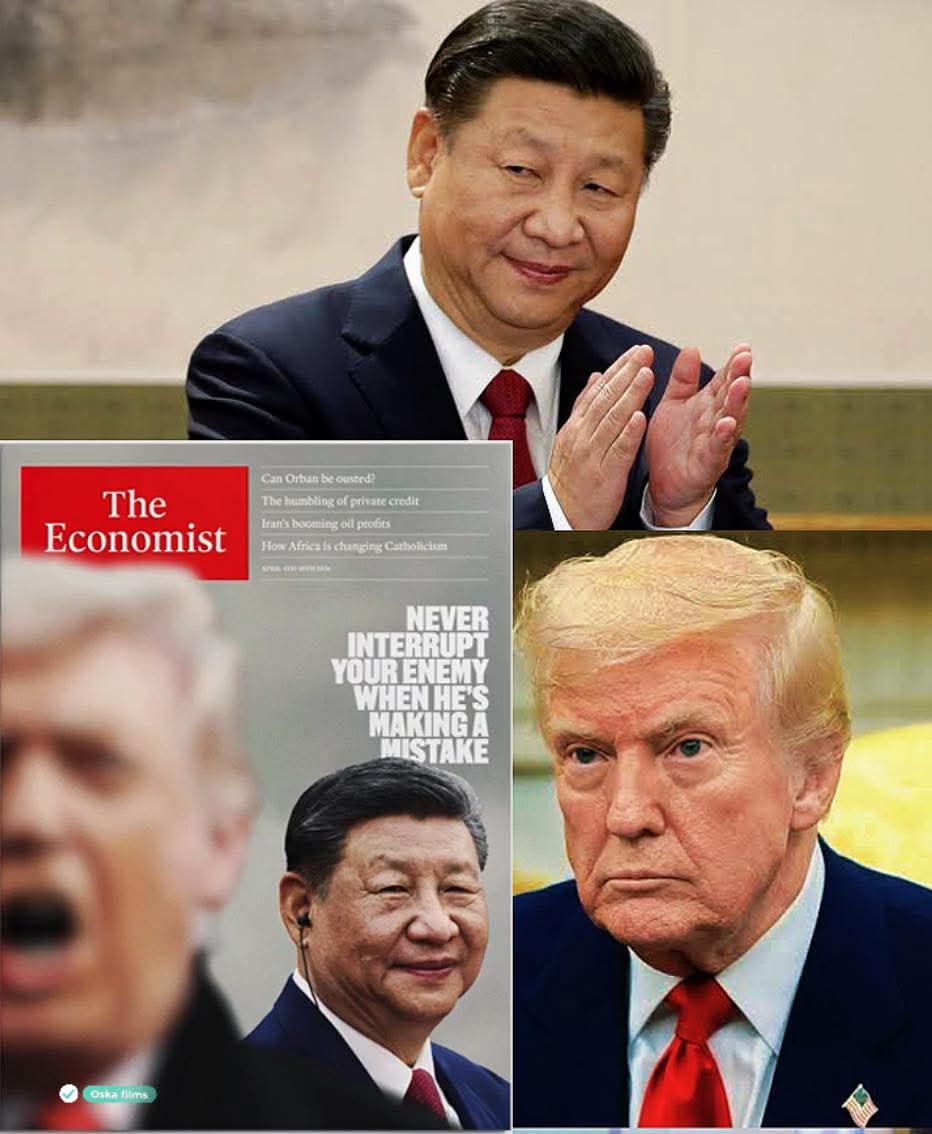
In a striking new cover illustration, British weekly The Economist has captured a pivotal shift in global power dynamics with a simple yet provocative message: “Never interrupt your enemy when he is making a mistake.”
The latest edition, dated April 4, 2026, features Chinese President Xi Jinping calmly observing in the background while a blurred U.S. President Donald Trump appears in the foreground, amid escalating U.S. military involvement in the Middle East conflict with Iran. The cover accompanies a leader article titled “How China hopes to win from the war,” which argues that Beijing is deliberately adopting a strategy of strategic patience as Washington risks overextending itself.1ee801
The quote, often attributed to Napoleon Bonaparte, has been embraced by Chinese strategists and diplomats as a guiding principle in the current crisis. According to The Economist, many in Beijing view America’s deepening entanglement in the Iran war — including blockades, troop deployments to the Gulf, threats, and direct military actions — as a self-inflicted wound that accelerates U.S. decline while leaving China relatively unscathed.
A Calculated Wait-and-See Approach
As the U.S. and its allies press forward in efforts to weaken Iran’s regime and curb its nuclear ambitions, China has largely stayed on the sidelines. Rather than intervening to support its partners or confronting Washington directly, Beijing is positioned to benefit from the fallout: higher global energy prices that could strain Western economies, diverted U.S. military resources away from the Indo-Pacific, and eroded American credibility as it appears bogged down in another protracted Middle Eastern conflict.
“Going to war against Iran promised to change the Middle East by weakening a villainous regime… [but] to its most bullish supporters, the war would also change the world by cowing an ascendant China,” the article notes. Instead, it suggests the opposite may be unfolding: America’s control over oil flows is being tested, while China’s reluctance to intervene highlights a contrast in strategic styles — military assertiveness versus economic resilience.bef8d9
While Washington deploys more troops, enforces blockades, and issues threats, China continues to expand its global infrastructure and trade networks. Analysts point out that Beijing is building bridges through initiatives like the Belt and Road, securing energy supplies through diversified partnerships, and positioning itself as a stable alternative to an overstretched superpower.
Contrasting Strategies: Bombs vs. Trade
The divergence is stark. The U.S. finds itself navigating complex alliances, potential ground operations in Iran, and risks to global shipping lanes — including recent Houthi attacks and strikes on oil tankers. China, by contrast, is portrayed as quietly capitalizing on these distractions. Its economy, though facing its own challenges, benefits from relative stability as competitors expend blood and treasure.
Chinese experts, speaking to The Economist, have revived the Napoleonic maxim, seeing U.S. actions in the region as a strategic blunder that plays into Beijing’s long-term patience. While some in the West frame America’s moves as necessary deterrence and leadership, much of the Global South views China’s non-intervention as pragmatic wisdom — letting an adversary exhaust itself.
This episode underscores broader questions about the future of great-power competition. Can the United States sustain multiple fronts without ceding ground elsewhere? Will prolonged conflict in the Middle East diminish its ability to counter China’s rise in technology, trade, and influence across Asia, Africa, and Latin America?
The Economist stops short of declaring American decline inevitable but warns that the current path risks handing Beijing a bloodless advantage. As Xi observes from afar, the magazine suggests, China is living the strategy: stand still, grow steadily, and let the rival’s momentum become its own undoing.
The cover has already sparked intense debate online and in diplomatic circles, with some hailing it as a sharp geopolitical insight and others criticizing it as overly pessimistic about U.S. resolve. Regardless, it highlights a key reality in 2026: in an era of great-power rivalry, sometimes the most effective move is no move at all.
“Never interrupt your enemy”: The economist’s cover warns US overextension in Iran could hand strategic victory to China

Try our mobile app
Never miss an update. Read anytime, anywhere with our mobile app.


- Advertisment -