



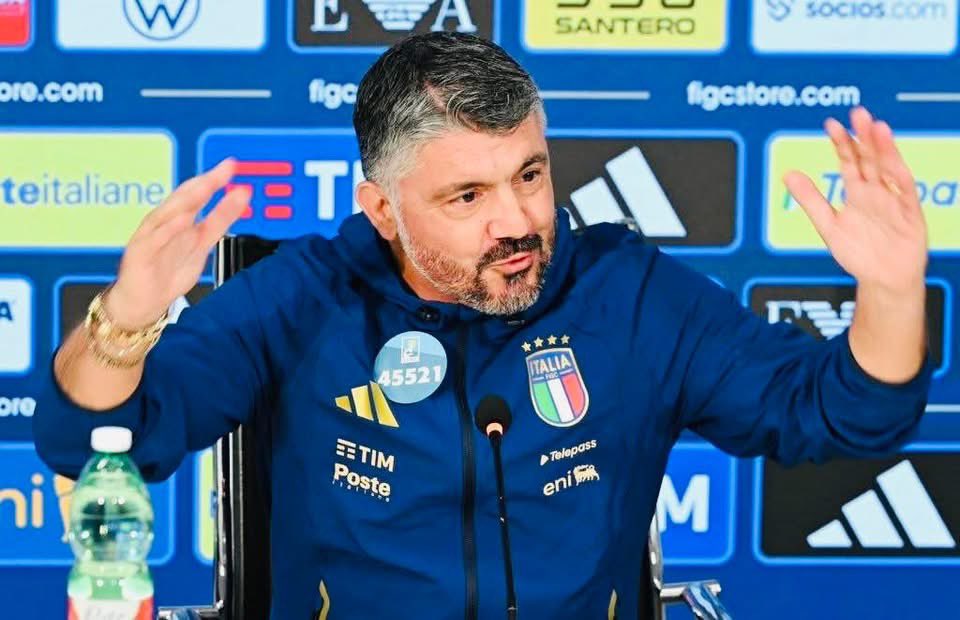
Former Italy midfielder Gennaro Gattuso has launched a blistering attack on FIFA’s World Cup qualifying system, arguing that the current format is “absurd and unfair” after Italy failed to reach the tournament despite amassing 18 points in their group.
Speaking in a recent interview, the fiery 2006 World Cup winner did not hold back as he contrasted Italy’s narrow miss with the guaranteed spots allocated to African and smaller nations.
“Italy lost just two matches in the group, earned 18 points and still didn’t qualify for the World Cup,” Gattuso said. “But 10 African teams qualified? Who is going to watch them?”
The former AC Milan and Napoli coach went further, questioning the global appeal of certain qualified nations. “Are you going to sit in front of the TV for Cape Verde or Curaçao?” he asked. “These qualifying rules are absurd and unfair.”
A System Under Scrutiny
Gattuso’s comments shine a light on a long-simmering debate over how FIFA allocates its 32 World Cup spots (set to expand to 48 in 2026). Italy’s painful playoff elimination at the hands of North Macedonia in March 2022—just months after finishing second in their UEFA group with 18 points from eight matches—remains a fresh wound for the four-time champions.
Under the current system, UEFA (Europe) receives 13 slots, while the Confederation of African Football (CAF) gets five—set to rise to nine under the expanded 48-team format. Smaller associations like the Oceania Football Confederation (OFC) are guaranteed at least one slot in the new system, which Gattuso clearly views as prioritizing geographic diversity over competitive merit.
The Other Side of the Argument
Critics of Gattuso’s position argue that the World Cup’s very purpose is global inclusion, not simply assembling the 32 “best” teams by ranking. Supporters of the expanded format point to unforgettable moments like Senegal’s 2002 quarterfinal run or Ghana’s 2010 penalty shootout heartbreak against Uruguay—matches that drew massive global audiences.
FIFA has consistently defended the expansion to 48 teams as a way to grow the sport worldwide. President Gianni Infantino has argued that more nations qualifying generates greater investment and participation across Africa, Asia, and the Americas.
‘Elitist and Out of Touch’
Football governance experts were quick to push back on Gattuso’s remarks. “Calls to reduce African or smaller nations’ representation ignore that Italy failed to beat North Macedonia—a country of just two million people—in a playoff,” said one football analyst. “Blaming the format rather than the performance is a convenient excuse.”
Others noted that Cape Verde (population 593,000) and Curaçao (population 155,000) have passionate football cultures, and their qualification would be celebrated by millions across their regions and diaspora communities.
What’s Next?
Gattuso, currently without a managerial role since leaving Marseille in February 2024, has never been afraid of controversy. But his latest outburst is likely to reignite the perennial debate: Should the World Cup prioritize the “best” teams on paper, or ensure the tournament truly belongs to the world?
For Italian fans still smarting from back-to-back World Cup absences (2018 and 2022), Gattuso’s frustration is deeply relatable. But whether his solution—fewer guaranteed spots for developing football nations—gains any traction outside of Europe’s elite remains highly doubtful.
FIFA declined to comment on Gattuso’s remarks.


