



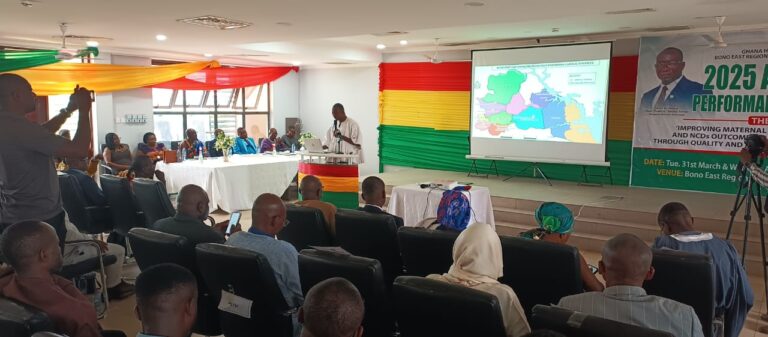
The Bono East Regional Director of the Ghana Health Service, Dr. Freeman Samson Samani, has raised serious concerns over significant inequalities in healthcare access across the region, revealing that three out of the eleven districts currently operate without a single hospital.
Dr. Samani made the disclosure during the 2025 Health Sector Annual Performance Review, held at the conference hall of the Bono East Regional Coordinating Council in Techiman. He noted that while urban centers like Techiman and Kintampo are relatively well-served, rural districts such as Pru West and Sene East remain critically deprived.
“Across our region, access to health care is not the same for everyone. In urban centers like Kintampo and Techiman, there is a concentration of facilities, both public and private, with over twenty health facilities available in Techiman alone, while districts such as Pru West and Sene East do not even have a single hospital. In fact, three out of the eleven districts in this region currently have no hospital at all,” he stated.
The Director highlighted the dire consequences of this disparity, particularly for emergency cases. He explained that survival often depends on distance and travel time, noting that pregnant women facing labor complications are among the most vulnerable.
“What this means in practical terms is that if a woman develops a complication during labor, or a patient suffers a medical emergency, their chances of survival may depend on how far they are from care and how quickly they can get there,” Dr. Samani said.
He further described the perilous conditions residents in hard-to-reach areas face, citing long travel distances, rough terrain, and dangerous water crossings.
“For many of our people, that journey is long, difficult, and sometimes dangerous, involving travel across water from riverine communities without safe and reliable transport. Others can only be reached by motorbike through rough terrain, with no proper roads. So even when services exist, people simply cannot reach them in time. And these delays can mean the difference between life and death,” he disclosed.
Dr. Samani emphasized that addressing healthcare challenges requires a multi-sectoral approach, calling for a more equitable distribution of health facilities and improved infrastructure to ensure no community is left behind.
“Health, therefore, is not only about what happens in our facilities. It is shaped by what happens outside the health sector—our roads, our transport systems, and the conditions in which our people live. This is why healthcare must be seen as an all-of-society responsibility,” he noted.
Looking ahead, the Regional Director outlined key priorities for 2026, including expanding access to primary healthcare in underserved areas, strengthening referral systems and emergency transport, improving maternal and newborn care, scaling up the management of non-communicable diseases, and advocating for a fairer distribution of health facilities.


