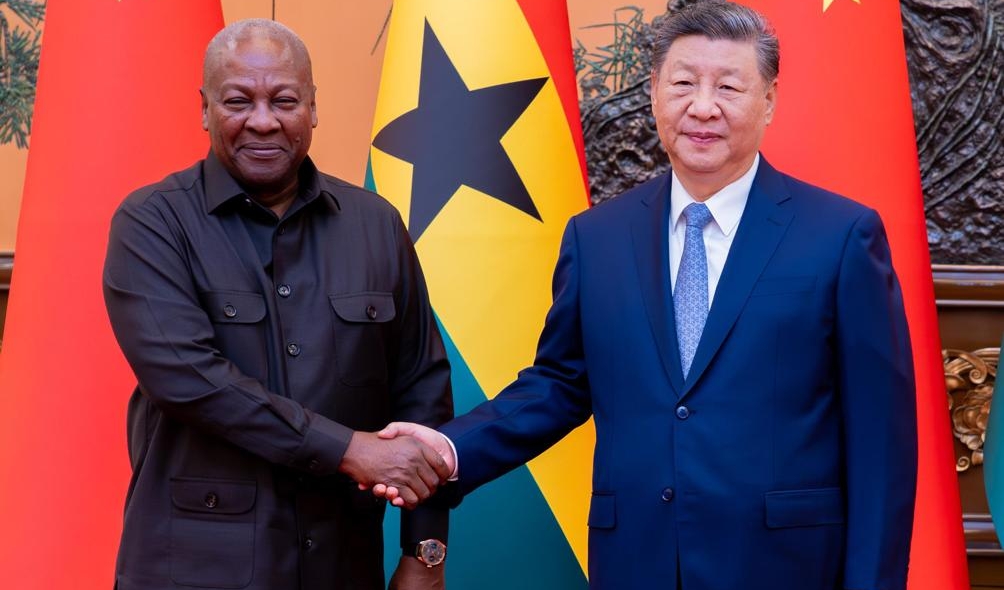
President John Dramani Mahama has appealed to Chinese industries to strengthen economic ties with Ghana by forming strategic partnerships with local businesses to process raw materials within the country for export to the Chinese market.
Speaking in a wide-ranging exclusive interview with China Global Television Network (CGTN), the President outlined a new model of cooperation centred on manufacturing and value addition, rather than the traditional focus on raw resource extraction and infrastructure financing.
President Mahama explained that Ghana is seeking to move away from exporting raw commodities such as cocoa, timber and mineral ores, and instead prioritise the export of finished and semi-finished products. He said the approach is essential for creating jobs, promoting technology transfer and stabilising the economy by reducing dependence on fluctuating global commodity prices.
According to him, Ghana wants Chinese companies to collaborate with Ghanaian firms to add value to raw materials locally before exporting them back to China, a move that aligns with the country’s long-term industrialisation strategy to increase manufacturing’s contribution to Gross Domestic Product (GDP).
During the interview, President Mahama also praised China’s significant role in supporting development across Africa, particularly through large-scale infrastructure projects. He cited Ghana’s benefit from Chinese-financed initiatives such as hydroelectric dams, road networks and port expansions, often executed through concessional loans and government-to-government agreements.
Describing China as a trusted partner, the President said the relationship has helped many African countries invest in critical infrastructure and advance their development objectives. He noted that for many African leaders, cooperation with China offers a practical alternative to traditional Western development models, especially in terms of speed and scale of delivery.
Beyond economic cooperation, the interview touched on broader historical and global issues, including the enduring impact of slavery and colonialism. President Mahama reaffirmed Ghana’s position that the transatlantic slave trade remains the most grievous crime in human history.
He revealed that Ghana plans to table a motion at the United Nations General Assembly next year, calling for global recognition of the slave trade as the greatest crime against humanity. The move, he said, reflects Ghana’s historical role as the “Gateway to Africa” and its commitment to moral leadership and the pursuit of global acknowledgment and restorative justice.