



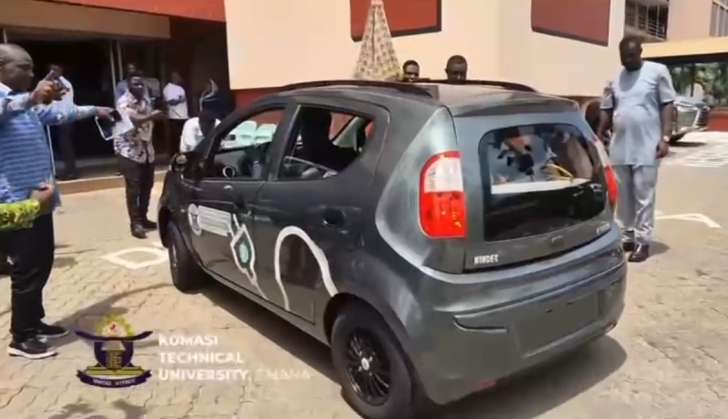
Kumasi Technical University (KsTU) has unveiled an electric vehicle equipped with regenerative braking technology, marking a significant advancement in locally driven sustainable transport innovation in Ghana.
The five-seater vehicle, named Nimde3 Hyiren REV, was developed over six months by three final-year students as part of their Bachelor of Technology (BTec) in Automotive Engineering programme. The project was supervised by Professor Prince Owusu-Ansah, Head of the Automotive and Agricultural Mechanisation Department, with additional support from industry partners.
Self-charging capability
The vehicle’s distinguishing feature is its regenerative braking system, which enables the battery to recharge automatically while the car is in motion, particularly when the driver decelerates or applies the brakes. This innovation contrasts with conventional electric vehicles that require stationary charging at designated points when battery levels run low.
According to the university, the initiative responds to the global shift toward sustainable mobility while adapting such technologies to Ghana’s transport and energy requirements. The vehicle can achieve speeds of up to 150 kilometres per hour.
The official unveiling took place on Saturday, March 28, 2026, during a durbar marking the university’s 70th-anniversary celebrations.
Academia-industry collaboration
Addressing the ceremony, Vice-Chancellor Professor Gabriel Dwomoh said the university had advanced existing electric vehicle concepts by introducing regenerative capabilities. He praised the collaboration between academia and industry, stating: “This is what we can achieve if academia and industry come together.”
Professor Dwomoh also highlighted other innovations developed by the university, including a multi-purpose rocket stove, a multi-purpose food dryer, a fish smoker, an RC feeder, drones, an electronic food warmer, a mini-cement mixer, and an air quality monitor.
“I wish to call on our partners, the government, and the private sector to join us as we embark on the next phase of our journey. That is, focusing on digitalisation, artificial intelligence, and sustainable engineering,” he said.
Built from scratch
In an interview, Professor Owusu-Ansah explained that the vehicle was constructed entirely from scratch and represents a departure from existing electric vehicles that rely solely on external charging.
“With our innovation, as the driver reduces the vehicle’s speed or steps on the brake while driving, the generator will automatically charge the battery,” he said. “This is to prevent the battery from running low before being charged. For instance, it can travel from Kumasi to Konongo and back without the battery being charged.”
He added that as long as the vehicle remains in motion, its battery continues to recharge, unlike conventional electric vehicles.
Future plans
Professor Owusu-Ansah indicated that the university intends to refine the technology and scale up production to include larger vehicles.
“As a faculty, we are not going to rest on what we have achieved but will improve upon the vehicle in terms of its speed and other key aspects,” he said, adding: “If anyone needs one and makes payment, it will be ready in six months.”


