



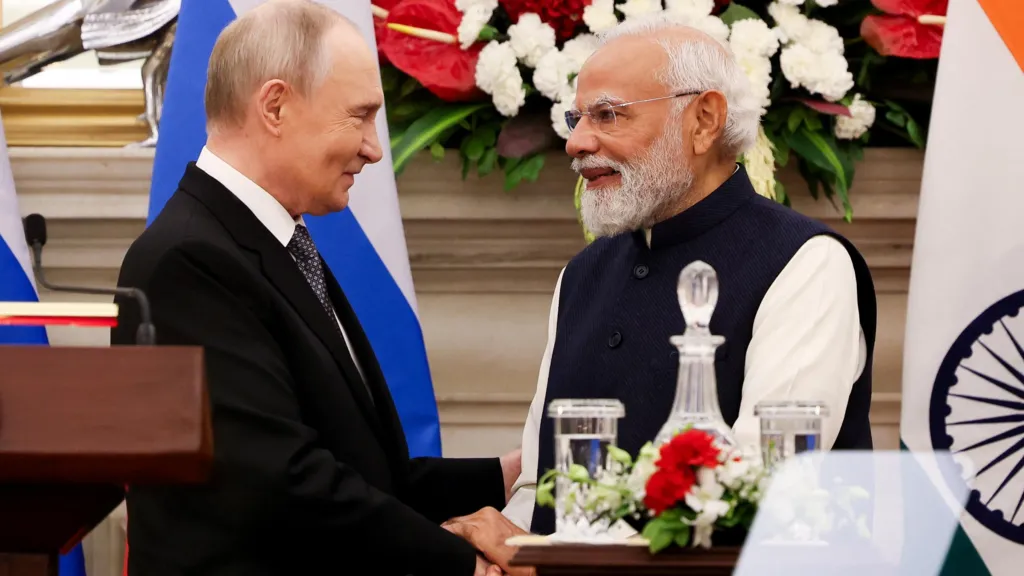
Russian President Vladimir Putin has said Moscow is ready to ensure “uninterrupted shipments” of fuel to India, as New Delhi comes under increasing pressure from the United States to halt its purchases of Russian oil.
Speaking alongside Indian Prime Minister Narendra Modi during a visit to Delhi, Putin questioned why India should face penalties for buying Russian energy when the US itself continues to import nuclear fuel from Moscow.
US President Donald Trump has imposed 50% tariffs on most Indian goods, arguing that India’s continued oil imports from Russia help finance the war in Ukraine — an allegation India has strongly rejected.
Putin’s visit comes at a time when Washington is holding talks with both Russia and Ukraine in an effort to broker a peace agreement to end the conflict.
In an interview with India Today on Thursday, Putin said Russia was pursuing a “peaceful solution” to the war, but warned that Ukraine must withdraw from the Donbas region or face further Russian military action. “Either we liberate these territories by force, or Ukrainian troops will leave,” he said.
Prime Minister Modi reiterated India’s position that it is not neutral on the war and stands “on the side of peace,” while welcoming international efforts aimed at achieving a lasting settlement. He also said strengthening connectivity between India and Russia remains a key priority for New Delhi.
Relations between India and the US have recently deteriorated, with tensions rising over unresolved tariff disputes. Trump initially imposed a 25% tariff on Indian products, later adding another 25% as a penalty for India’s purchase of Russian oil — a move India previously described as “unfair, unjustified and unreasonable.”
Commenting on the tariffs, Putin argued that India should enjoy the same privileges as the US. “The United States itself still buys nuclear fuel from us. If the US has that right, why shouldn’t India?” he asked.
According to Bloomberg, Russia remained the largest supplier of nuclear reactor fuel to the US last year, based on data from the Department of Energy, even though a ban on enriched uranium imports from Russia was passed into law in May.


