



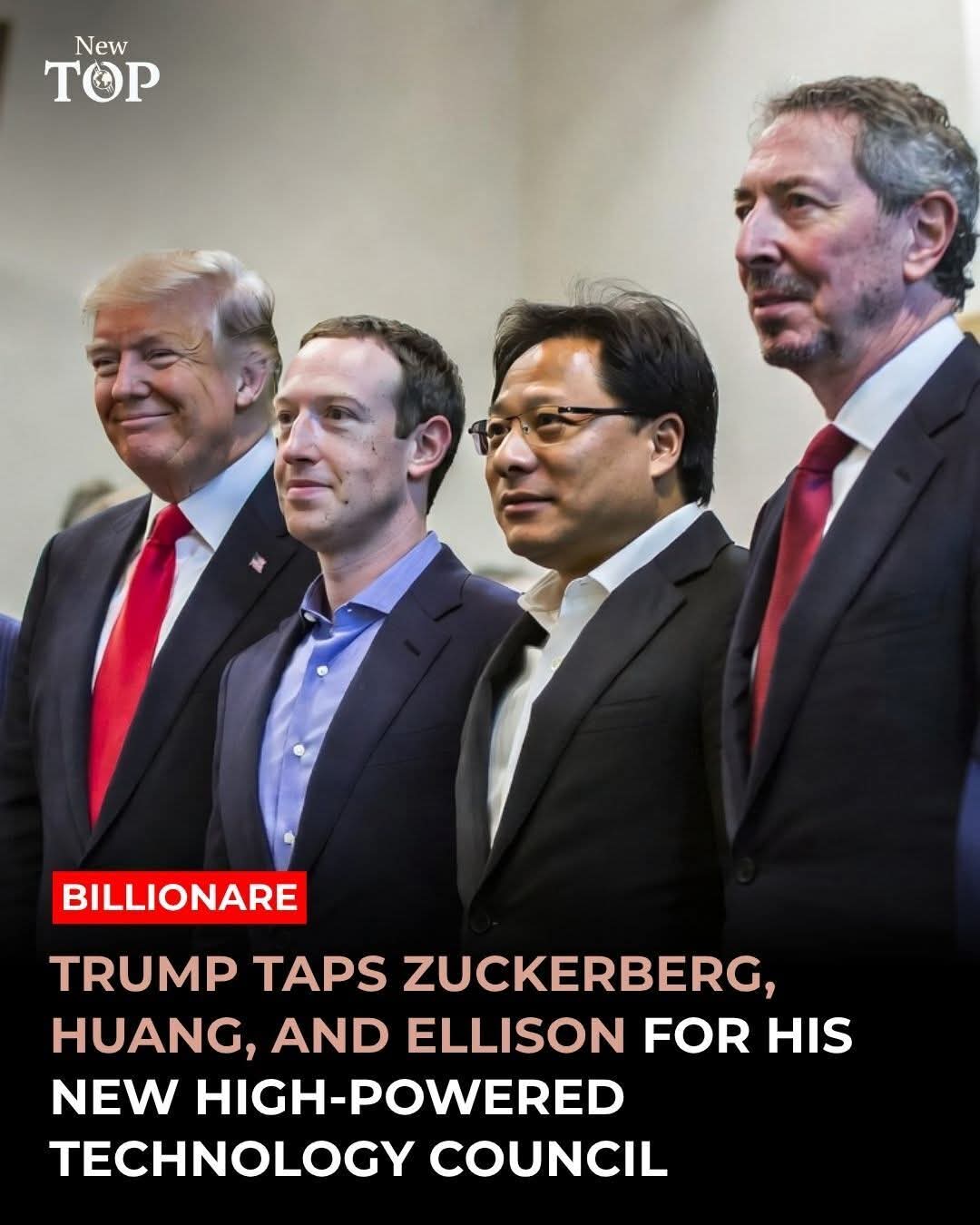
President Trump has formally convened a star-studded group of technology executives to serve on his revived President’s Council of Advisors on Science and Technology (PCAST), bringing together some of Silicon Valley’s most influential figures to guide federal policy on artificial intelligence, cybersecurity, and emerging technologies.
The newly formed council includes Meta CEO Mark Zuckerberg, Nvidia CEO Jensen Huang, Oracle chairman Larry Ellison, Google co-founder Sergey Brin, and AMD CEO Lisa Su among its initial 13 members . The panel, which can expand to as many as 24 members under an executive order issued in January 2025, will provide the White House with expert guidance on science and technology policy .
The appointments mark a significant shift in the relationship between Washington and the technology sector, representing a far more industry-heavy roster than the president’s first-term advisory council . The group will be co-chaired by David Sacks, Trump’s AI and crypto czar, and Michael Kratsios, the White House technology adviser .
Industry Heavyweights Bring Diverse Expertise
The selection of members reflects the administration’s focus on dominating the global AI landscape. Huang, whose company Nvidia controls more than 90% of the high-end AI chip market, brings critical expertise in the hardware underpinning artificial intelligence development . Zuckerberg’s inclusion signals the importance of AI applications and social platforms, while Ellison’s Oracle provides essential database and cloud infrastructure .
“The United States has the opportunity to lead the world in AI,” Zuckerberg said in a statement. “I’m honored to join the president’s council and work with other industry leaders to help make this happen” .
The council also includes venture capitalists Marc Andreessen and David Friedberg, Commonwealth Fusion Systems CEO Bob Mumgaard, and several other technology executives and scientists .
Balancing Expertise and Influence
The council’s formation has drawn both praise and skepticism. Supporters argue that bringing top industry minds directly into the policy-making process ensures that federal technology strategy benefits from real-world expertise . The panel is expected to play a key role in shaping Washington’s response to intensifying global competition in artificial intelligence, particularly from China .
However, critics warn that the concentration of billionaires and corporate leaders in an advisory role raises concerns about industry influence over public policy . Recent polling shows Americans are increasingly wary of Big Tech’s influence on Washington, and the growing closeness between the White House and Silicon Valley has begun generating political backlash .
The advisory body, which dates back to President Franklin Roosevelt, produces reports and recommendations on topics the president directs it to study but has no regulatory or enforcement powers . Past councils have addressed issues ranging from pandemic preparedness to quantum computing and clean energy .
A New Era of Tech-Government Alignment
The appointments represent the latest sign of deepening ties between the Trump administration and Silicon Valley — a marked departure from the president’s first term, when many tech executives maintained their distance . The administration has made securing U.S. leadership in artificial intelligence a central priority, framing the technology as a defining arena of strategic competition with China .
Within days of taking office, Trump directed federal agencies to prepare an AI Action Plan aimed at reducing regulatory barriers and accelerating private-sector innovation . The new council is expected to provide guidance on implementing that vision while advising on workforce development, national security implications, and maintaining U.S. technological competitiveness .
Some observers have characterized the evolving relationship as the emergence of a “tech-industrial complex” — a parallel to the military-industrial complex that has long shaped defense policy . Unlike traditional lobbying arrangements, this structure places technology leaders directly within the advisory apparatus of the executive branch .
Global Implications
The formation of the council comes as global competition in artificial intelligence intensifies. The United States, China, and the European Union have each adopted distinct approaches to AI development and regulation, with the EU pursuing strict oversight while the U.S. emphasizes innovation and industry growth .
Trump has repeatedly emphasized that the U.S. “has the opportunity to lead the world in AI,” framing the administration’s policies as enablers of a “Golden Age of Innovation” . With tech executives now positioned to directly shape those policies, the administration is betting that private-sector expertise can help secure American dominance in what it views as the defining technology of the coming decades .
The White House has indicated additional members will be appointed to the council in the near future.


