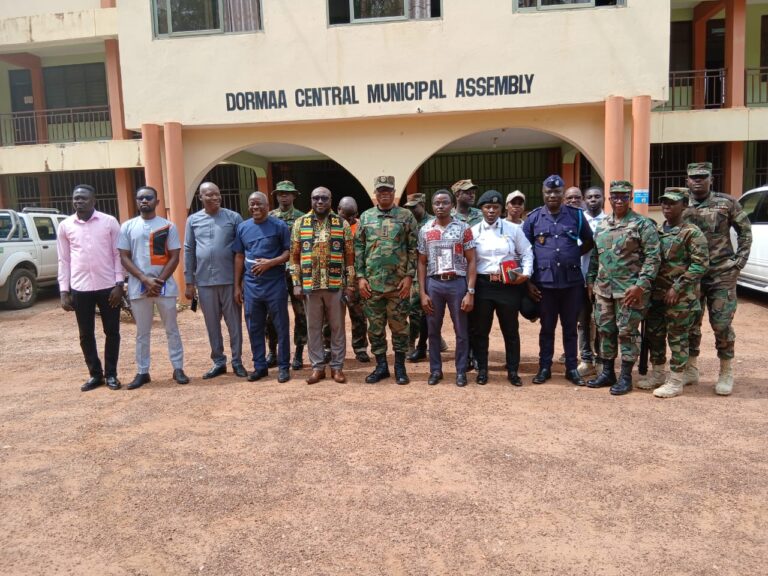
A week-long field assessment by the Ghana Boundary Commission has confirmed widespread concerns over damaged boundary infrastructure and underdevelopment in several border communities in the Bono Region, raising fresh questions about boundary management and human security.
The exercise, led by the Commissioner-General, Major General Anthony Ntem, took the team across strategic locations within the Dormaa Central and Jaman South Municipalities along Ghana’s western frontier with Côte d’Ivoire. The mission formed part of ongoing efforts to assess the condition of Ghana’s international boundaries and engage communities directly affected by cross-border dynamics.
Deteriorating Boundary Markers
On the ground, the team observed that while a number of boundary pillars remain intact and visible, several others have either been displaced, broken, defaced, or completely eroded. These findings corroborate earlier reports submitted by officers of the Customs Division of the Ghana Revenue Authority and the Ghana Immigration Service, who had raised red flags about the deteriorating state of some of the country’s boundary markers.
Officials explained that the destruction of these pillars is the result of a combination of human activities, including farming and encroachment, as well as natural environmental factors such as erosion and weather conditions. The situation, they warned, could complicate efforts at clear boundary demarcation, potentially creating vulnerabilities that may be exploited for cross-border crimes and disputes.
The Commission further indicated that although Ghana and Côte d’Ivoire are currently undertaking a Joint Boundary Reaffirmation Exercise aimed at replacing and restoring international boundary pillars along their shared land border, the affected municipalities have not yet been included in the ongoing phase. Authorities, however, expressed confidence that the concerns identified would be addressed under Phase Three of the exercise, where reconstruction and reinforcement works are expected to cover these areas.
Development Deficit and Human Security Challenges
Beyond the state of the physical boundary, the exercise brought to light significant developmental and human security challenges confronting residents in these frontier communities. A needs assessment conducted by the Commission revealed that many of the settlements lack access to essential services such as potable water, healthcare facilities, quality roads, and educational infrastructure, leaving residents to cope with harsh living conditions.
In communities such as Gonokrom, Kofi Badukrom, Kwamesiekrom, Drobo, Batia, Atuna, and Kwameprakrom, a common concern emerged: residents expressed frustration over years of neglect and called for urgent government intervention to improve infrastructure and economic opportunities. Despite their critical role in safeguarding Ghana’s territorial boundaries, these communities continue to lag behind in development.
Stakeholder Engagement
Throughout the exercise, the Commission engaged extensively with stakeholders at various levels, including the Bono Regional Minister, Municipal Chief Executives, and members of the Municipal Security Councils. The team also held discussions with traditional leaders and community members, whose insights provided a clearer picture of the everyday realities and risks associated with living along the border.
Call for Urgent Action
The Commission stressed that the findings from the exercise point to a dual challenge that requires immediate attention: the need to rehabilitate and maintain boundary infrastructure, and the urgency of addressing socio-economic deprivation in border areas. According to officials, strengthening both aspects is essential not only for protecting Ghana’s territorial integrity but also for enhancing the livelihoods and security of people living along the country’s frontiers.