



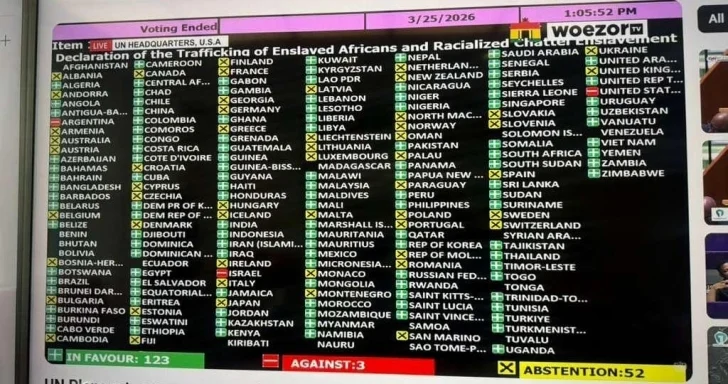
The United Nations General Assembly has officially recognized the transatlantic slave trade as “the gravest crime against humanity,” adopting a landmark resolution on March 25, 2026, proposed by Ghana and backed by 123 member states.
The resolution, which urges nations to consider formal apologies and contribute to a reparations framework, marks a significant step in international acknowledgment of historical injustices inflicted upon Africa. While it does not specify financial reparations, it calls for a broader reparative justice approach to address the enduring consequences of enslavement and colonization.
The measure was adopted despite opposition from the United States, Israel, and Argentina. Fifty-two countries, including the United Kingdom and several European Union members, abstained.
Ghana’s Foreign Minister, Samuel Ablakwa, emphasized that the resolution underscores the need for accountability for centuries of enslavement and colonization. Speaking on behalf of the African Union at the UN General Assembly in New York, President John Dramani Mahama framed the resolution as a moral imperative and called for global support.
“Let it be recorded that when history beckoned, we did what was right for the memory of the millions who suffered the indignity of slavery,” President Mahama said. “Let our vote on this resolution restore their dignity and humanity.”
The draft resolution, titled “Declaration of the Trafficking of Enslaved Africans and Racialised Chattel Enslavement of Africans as the Gravest Crime Against Humanity,” also advocates for the return of cultural artifacts, reforms to global systems to ensure equitable opportunities, and enhanced protections for Africans and the diaspora.
President Mahama stressed that neutrality on such moral issues serves injustice, quoting Theodore Roosevelt: “With a great moral issue involved, neutrality does not serve righteousness; for to be neutral between right and wrong is to serve wrong.”
UN Secretary-General António Guterres welcomed the resolution but called for “far bolder action” from member states to confront the lingering structures of racial inequality and white supremacy that continue to affect people of African descent. He urged the dismantling of false narratives in media, education, and politics, stressing that leaders must use power constructively to address systemic racism and promote inclusive development.
The resolution forms part of broader efforts by African and Caribbean nations to seek accountability for historical injustices, including proposals for a dedicated UN reparations tribunal. Minister Ablakwa noted that the initiative could pave the way for a “reparative framework” addressing both historical wrongs and their ongoing consequences in economic and social disparities.
President Mahama underscored the importance of remembering the estimated 12.5 million victims of the slave trade, using their memory as a foundation for collective healing.
“Through these activities, we do more than remember,” he said. “We document and educate; we gain a greater perspective; we find the delicate balance of learning from history so we do not repeat it, while leaving the pain behind. In doing so, we begin to heal, individually, within our immediate communities, and within the global community.”


