



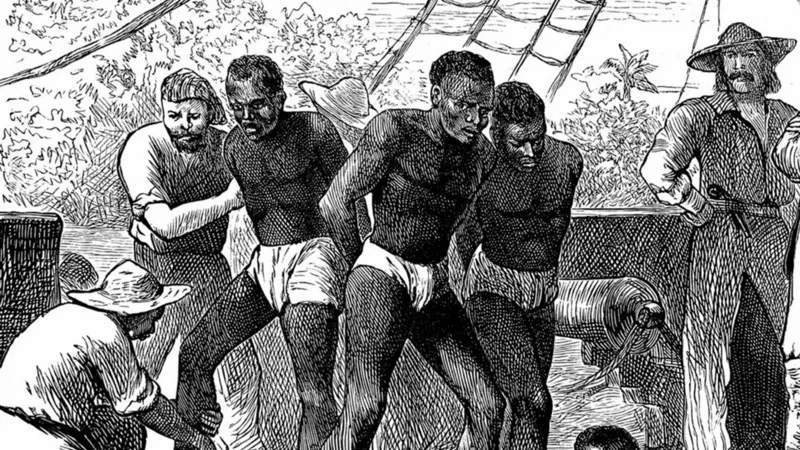
Ghana has introduced a landmark resolution at the United Nations General Assembly calling for the transatlantic slave trade to be formally recognized as “the gravest crime against humanity,” with the West African nation demanding that member states consider issuing formal apologies and contributing to a reparations fund.
The proposal, led by Ghana and backed by the African Union and the Caribbean Community, is expected to face resistance from European nations, including the United Kingdom, which have long rejected financial reparations on the grounds that modern institutions should not be held liable for historical wrongs.
Samuel Okudzeto Ablakwa, Ghana’s foreign minister, said ahead of the vote that the initiative was about securing justice rather than personal enrichment.
“We are demanding compensation – and let us be clear, African leaders are not asking for money for themselves,” Ablakwa told the BBC. “We want justice for the victims and causes to be supported, educational and endowment funds, skills training funds.”
The resolution, tabled on Wednesday, argues that the consequences of slavery persist in the form of racial inequalities and underdevelopment “affecting Africans and people of African descent in all parts of the world.”
Ablakwa emphasized that Ghana was not ranking historical suffering but documenting a historical fact, noting that many generations “continue to suffer the exclusion, the racism because of the transatlantic slave trade which has left millions separated from the continent and impoverished.”
Between 1500 and 1800, an estimated 12 to 15 million Africans were captured and transported to the Americas, where they were forced into slavery. More than two million are believed to have died during the crossing.
The resolution also calls for the return of cultural artefacts looted during the colonial era.
“We want a return of all those looted artefacts, which represent our heritage, our culture and our spiritual significance,” Ablakwa said.
Ghana, one of the primary departure points for the transatlantic slave trade, has long been a leading voice on reparatory justice. Slave forts, where thousands were held in inhuman conditions before being shipped across the Atlantic, remain standing along its coastline.
The campaign for reparations has gained momentum in recent years. “Reparatory justice” was adopted as the African Union’s official theme for 2025, and Commonwealth leaders have jointly called for dialogue on the matter.
Speaking before the UN on Tuesday, Ghana’s President John Dramani Mahama described the resolution as “historic” and “a safeguard against forgetting.”
He also used the address to criticize the administration of U.S. President Donald Trump, accusing it of “normalising the erasure of black history.” Mahama said policies targeting American cultural and historical institutions risked becoming a template for other governments.
“These policies are becoming a template for other governments as well as some private institutions,” Mahama said.


