



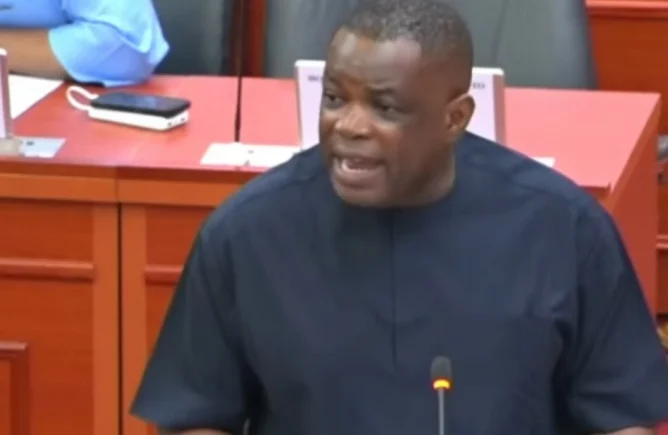
The Minister for Roads and Highways, Kwame Governs Agbodza, has firmly rejected allegations that the government’s flagship Big Push Infrastructure Programme is being implemented through widespread sole sourcing, stating that the initiative is in full compliance with Ghana’s procurement laws.
Delivering a statement on the floor of Parliament on Tuesday, March 24, 2026, Mr Agbodza described the claims as “mischievous” and inconsistent with the facts presented to the House. He stressed that every contract awarded under the programme adheres strictly to the Public Procurement Act and its accompanying regulations.
To ensure transparency, the Minister noted that all details of awarded contracts are published on the Ministry’s website, allowing for full public scrutiny.
Addressing the procurement concerns directly, Mr Agbodza revealed that only 44 percent of major contracts—including those under the Big Push programme—were awarded through sole sourcing. He emphasised that more than 400 contracts have been secured through open competitive tendering.
“It is therefore misleading for any right-thinking person to conclude that the Ministry only relies on sole sourcing,” he told Parliament.
Expedited Approach to Tackle Road Crisis
Mr Agbodza explained that the scale and urgency of Ghana’s deteriorating road network necessitated a flexible but lawful procurement approach. He argued that relying solely on lengthy procurement procedures would have delayed critical projects and led to further cost escalations.
As part of the programme’s accelerated delivery, the Minister disclosed that 23 major road projects valued at GH¢14.88 billion—originally awarded under the previous administration but left uncompleted due to funding constraints—have been absorbed into the Big Push and given fresh financing. These include strategic projects such as the Suame Interchange, the Ofankor–Nsawam Road, and the Adenta–Dodowa Road.
The programme is structured around 12 key economic corridors, divided into 54 lots to enhance competition and speed up execution. According to the Minister, more than 2,000 kilometres of roads across all 16 regions are currently undergoing reconstruction or upgrading.
Safeguards and Oversight
On the issue of value for money, the Minister outlined a series of safeguards, including in-house surveying, design, and costing by state agencies to reduce expenses, alongside independent assessments of contractor proposals. He added that stricter monitoring systems have been introduced to ensure payments are tied directly to verified work done.
“We have established a system where no contractor will be paid without delivering measurable work,” he stated. He also noted that collaboration with the Ghana Institution of Surveyors is ongoing to strengthen independent cost verification.
Mr Agbodza dismissed criticisms based on cost-per-kilometre comparisons, arguing such assessments fail to account for differences in engineering complexity and associated infrastructure such as interchanges and bridges.
Contrast with Previous Administration
Contrasting the current approach with that of the previous administration, the Minister said several inherited projects from 2024 lacked commitment authorisation and were not subjected to competitive procurement processes, contributing to arrears exceeding GH¢40 billion.
He disclosed that the government has since paid more than GH¢11 billion to reduce that debt, describing it as the largest arrears settlement in recent history.
Reaffirming the government’s position, Mr Agbodza declared: “There is no abuse of sole sourcing. It is the exception, not the norm. No procurement law has been breached, and there is no scandal.”
He urged Parliament and the public to support the programme, cautioning against misinformation that could undermine what he described as a transformative effort to improve road infrastructure, reduce transport costs, and stimulate economic growth nationwide.
“The Big Push is delivering the infrastructure Ghanaians demanded,” he said. “We must not allow misinformation to derail it.”


