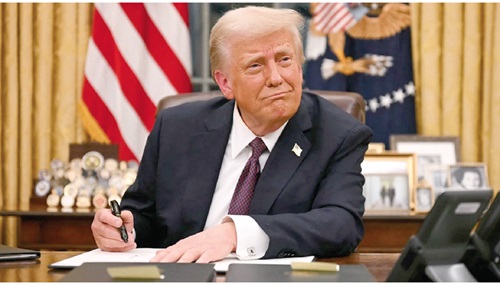
Oil prices tumbled in Asian trading on Wednesday after U.S. President Donald Trump announced progress in negotiations to end the ongoing war, while Iran signaled a potential reopening of the strategic Strait of Hormuz.
Brent crude futures fell by 5% to $99.29 a barrel, with U.S.-traded West Texas Intermediate (WTI) crude dropping more than 5.5% to $88.41.
President Trump told reporters on Tuesday that talks to end the conflict were happening “now,” adding that the parties involved “want to make a deal so badly.” He stated that Vice President JD Vance and Secretary of State Marco Rubio were participating in the discussions. The president also reiterated his claim that U.S.-Israeli strikes had led to “regime change” in Tehran and that Iranian leaders had agreed to forgo nuclear weapons.
However, Iranian officials have disputed these claims. On Monday, Tehran labelled reports of direct talks with the U.S. as “fake news,” even as strikes between Israel and Iran continued.
In a potential breakthrough for global energy markets, Iran’s mission to the United Nations announced that “non-hostile vessels” would be granted passage through the Strait of Hormuz. The mission stated on X that safe passage would be permitted for ships that coordinate with Iranian authorities and do not “participate in nor support acts of aggression against Iran.”
The Strait of Hormuz is a critical chokepoint through which approximately 20% of the world’s oil and liquefied natural gas typically passes daily. Iran had effectively blocked the waterway following the outbreak of the war.
The price drop suggests markets are pricing in a reduced risk of a prolonged supply disruption. “Trump’s remarks have raised hopes that the conflict will ease,” said Goh Jing Rong from the Singapore Management University. He cautioned, however, that the drop in prices will only be sustained if there is “credible follow-through,” such as guaranteed safe passage for vessels.
Meanwhile, hostilities persist. The Israel Defense Forces (IDF) said it had begun a “new wave of strikes” in Tehran, targeting infrastructure of the “Iranian terror regime.” The IDF also warned residents in Beirut’s southern suburbs to evacuate as it continued strikes against Hezbollah.
Despite the ongoing exchanges, Asian markets rallied on the news of potential de-escalation. Japan’s Nikkei 225 and South Korea’s Kospi, both heavily reliant on oil transiting the Strait, each rose by more than 2%. Australia’s ASX 200 gained over 1.8%.
The sharp fall in oil prices marks a reversal from recent highs, though prices remain significantly elevated compared to levels before the U.S. and Israel launched attacks on Iran on 28 February. Global energy prices have soared over the past month, prompting governments worldwide to implement measures to shield their economies from the impact.