



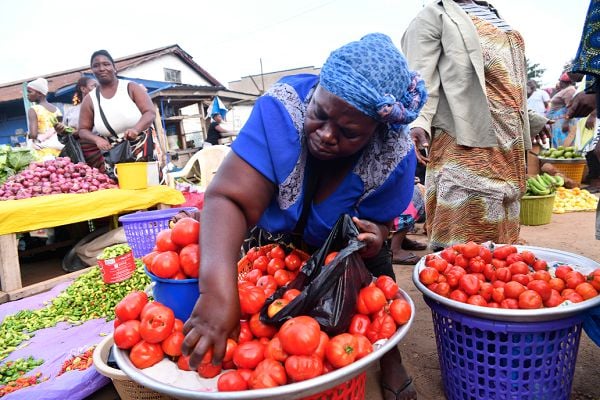
The Food and Beverages Association of Ghana (FABAG) has issued a sharp critique of the Ministry of Food and Agriculture, blaming policy failures for the current tomato shortage and calling for a fundamental restructuring of the sector.
The shortage follows a supply disruption triggered by a ban from Burkina Faso, a key source of tomatoes for Ghana. In a statement released on March 24, 2026, FABAG argued that the crisis exposes a deep structural weakness in the country’s agricultural planning.
The association questioned why Ghana, with its vast arable land, irrigation infrastructure, and agricultural institutions, remains dependent on imports for a basic food commodity.
“It is completely unacceptable that a country with vast agricultural land, irrigation dams, agricultural colleges, research institutions, extension officers, and a full Ministry of Food and Agriculture cannot produce enough tomatoes to feed its own population,” the statement read.
FABAG highlighted the short-cycle nature of tomato farming, noting that with proper irrigation and seed varieties, the crop can be harvested within 60 to 90 days. The association warned that any failure to resolve the shortage within this timeframe would represent a fundamental failure of leadership.
The group further cautioned that such reliance on external sources for food constitutes a national security risk, asserting that the core issue is not a lack of resources but a lack of coordination and execution.
To address the immediate crisis, FABAG is calling for a series of urgent measures. These include the declaration of a national emergency tomato programme, the rapid distribution of improved seeds and subsidized inputs, and the activation of irrigation systems for dry-season farming.
The association also proposed the mobilization of young people into commercial tomato farming, investment in greenhouse production and storage facilities, and the establishment of a clear national target to achieve tomato self-sufficiency within one year.
In a direct challenge to the sector’s leadership, FABAG issued an ultimatum, suggesting that if the ministry cannot organize tomato production under irrigation within the next two to three months, the government should consider restructuring it into a production-focused authority with clear targets and accountability.
The statement underscores mounting pressure on policymakers to translate agricultural strategy into tangible results as supply disruptions continue to test the nation’s food security.


