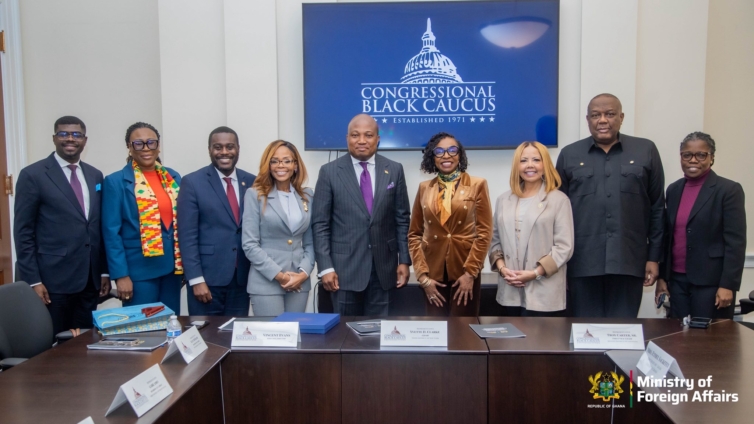
In a significant diplomatic breakthrough, the United States Congressional Black Caucus (CBC) has announced its unwavering support for Ghana’s proposed United Nations resolution seeking to classify the transatlantic slave trade as the gravest crime against humanity.
Ghana’s Minister for Foreign Affairs, Samuel Okudzeto Ablakwa, disclosed the development following high-level engagements with CBC leadership in Washington, where he is currently rallying support for the initiative championed by President John Dramani Mahama.
“I am in Washington to hold strategic engagements with the leadership of the influential and inspirational Congressional Black Caucus on President Mahama’s impending historic UN Resolution,” Mr Ablakwa stated.
The Minister expressed profound satisfaction with the outcome, revealing that the caucus—often described as the “Conscience of Congress”—has declared “100 per cent support” for Ghana’s draft resolution.
“Absolutely delighted to disclose that the Congressional Black Caucus has declared 100% support for Ghana’s UN Draft Resolution,” he said. “This endorsement from the Conscience of Congress is most cherished and deeply appreciated.”
The endorsement represents a major milestone in Ghana’s global advocacy for reparatory justice and international recognition of the historical injustices suffered by millions of Africans during the slave trade era. Mr Ablakwa noted that the development provides renewed momentum for the campaign.
“We clearly have an added momentum to our global campaign for reparatory justice,” he emphasised, highlighting the critical role of international solidarity in advancing the cause.
Beyond the immediate resolution, discussions also explored the establishment of a more structured, long-term partnership involving Ghana, the African Union, and the Congressional Black Caucus.
The Minister extended appreciation to CBC Chair Yvette D. Clarke and other members, including Gabe Felix Kofi Amo, expressing confidence in the collective effort.
“We are united to make history on March 25, 2026,” he declared.
The proposed resolution, if adopted by the United Nations, would represent a landmark moment in the global recognition of the transatlantic slave trade’s devastating impact and could pave the way for broader conversations on reparative justice.