



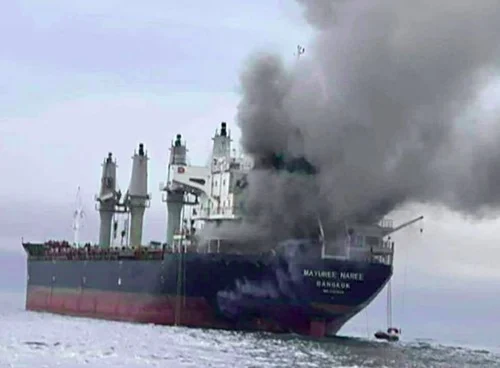
Global oil prices surged past the $100-per-barrel mark once again on Thursday, as a wave of Iranian missile and drone attacks on economic infrastructure across the Middle East overshadowed a historic release of government-controlled oil reserves.
The renewed spike in Brent crude, the international benchmark, which rallied 9% to $100.29, signals mounting global alarm over a sustained supply crisis. This escalation comes as former US President Donald Trump vowed to “finish the job” in backing Israel’s war effort against Iran, prompting Tehran to retaliate with strikes on key economic targets.
In a significant broadening of the conflict’s impact on global trade, several merchant vessels were hit in and around the Strait of Hormuz, a vital chokepoint through which roughly a fifth of the world’s oil passes. The owner of the Thai-registered tanker Mayuree Naree confirmed the ship was struck, adding that three crew members are “believed to be trapped” aboard.
The disruption has forced major operational halts across the region. Iraq has suspended all activity at its oil ports following attacks on two nearby tankers. In Bahrain, authorities imposed a lockdown in parts of the Muharraq Governorate after Iranian strikes targeted fuel storage tanks.
According to a Bloomberg report, Oman has evacuated all vessels from its primary oil export terminal at Mina Al Fahal—one of the last remaining operational export points in the region—after drone strikes hit another Omani port.
Economic Warfare Overshadows Record Reserve Release
The fresh violence has effectively neutralized an unprecedented intervention by the International Energy Agency (IEA). On Wednesday, the agency’s 32 member nations unanimously agreed to release 400 million barrels from government emergency stockpiles—the largest such coordinated action in history—in a bid to calm markets.
The move was swiftly eclipsed, however, by the reality of ongoing attacks and the perception that Tehran is deliberately targeting energy infrastructure. The de facto closure of the Strait of Hormuz since the conflict began on February 28 has crippled normal oil and gas flows, a situation Saudi Arabia’s state oil company, Aramco, has warned could have “catastrophic consequences” for global markets if it persists.
Taunting the United States, an Iranian military spokesperson linked the price surge directly to the conflict. “Get ready for oil to be $200 a barrel, because the oil price depends on regional security, which you have destabilised,” the spokesperson said.
US to Tap Reserves as Market Jitters Spread
As part of the IEA’s broader effort to stabilize the market, the United States announced plans to release 172 million barrels from its Strategic Petroleum Reserve. US Energy Secretary Chris Wright stated the release would begin next week and take approximately 120 days to complete, accusing Iran of having “manipulated and threatened the energy security of America and its allies.”
The impact of the crisis rippled through global financial markets on Thursday. In Asia, leading stock indices came under pressure, with Japan’s Nikkei 225 dropping 1.6% and South Korea’s Kospi falling 1.2%. The price of West Texas Intermediate (WTI), the US crude benchmark, also climbed sharply, rising 8.6% to $94.75 per barrel.


