



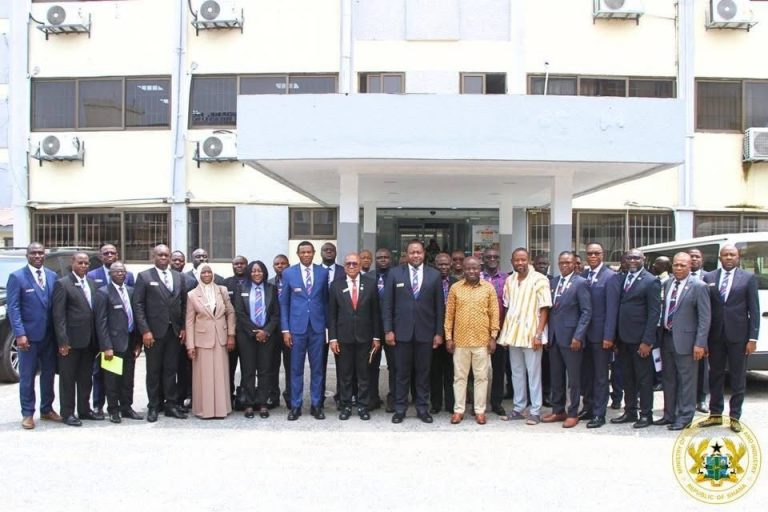
The Ministry of Trade, Agribusiness and Industry has hosted a high-level delegation from the Nigerian National Defense College as part of a regional study tour examining how Ghana’s cocoa sector drives economic growth.
The 29-member delegation visited the Ministry in Accra on Monday to gain practical insights into Ghana’s cocoa industry and identify lessons that could inform policy development and strategic planning in Nigeria.
Receiving the team, Director for Agribusiness Kwame Oppong-Ntim, along with other senior Ministry officials, outlined Ghana’s approach to transforming the cocoa sector beyond primary production.
While the Ghana Cocoa Board manages and regulates cocoa production, Oppong-Ntim explained that the Trade Ministry focuses on promoting value addition, facilitating investment, and expanding markets for cocoa-based products. The Ministry collaborates with institutions including the Ghana Investment Promotion Centre, Ghana Free Zones Authority, and Ghana Standards Authority to attract agro-processing investment and ensure exports meet international quality standards.
“As part of Ghana’s broader industrialisation agenda, government is intensifying efforts to increase local processing of cocoa beans into finished products such as chocolate, cocoa powder and other value-added derivatives,” Oppong-Ntim said. He noted this strategy aims to boost export revenue, create employment opportunities, and strengthen Ghana’s position in the global cocoa value chain.
Delegation seeks practical lessons
Leading the delegation, Tahir S. Ngada explained the visit forms part of the College’s academic programme under the theme “Cocoa Production and Economic Growth in Ghana: Lessons to Nigeria.”
The Nigerian National Defence College, established in 1992, provides advanced leadership training for senior officers from armed forces, security agencies, and public institutions across several countries. Ngada noted the regional study tour complements classroom instruction by exposing participants to real-world sectors that influence national power, including economic development.
During an interactive session, delegation members sought clarification on investment opportunities in cocoa processing, land tenure systems, government support for farmers, and measures to maintain economic stability.
Government interventions outlined
Responding to questions, Ministry officials detailed various interventions supporting cocoa farmers, including agricultural inputs, extension services, and productivity incentives rather than direct financial transfers.
They emphasised government’s commitment to promoting private sector participation in cocoa processing, noting most processing companies are privately owned while the state focuses on creating a favourable investment environment.
Officials acknowledged that illegal mining activities, locally known as galamsey, pose serious threats to cocoa production in certain areas. They explained that destruction of cocoa farms through such activities has contributed to declining output in recent years. However, government is strengthening coordinated action among state institutions and local communities to protect cocoa-growing areas.
The visit forms part of a broader academic programme enabling participants to study Ghana’s cocoa sector and draw lessons that could guide policy formulation and economic planning in Nigeria and other participating countries.


