



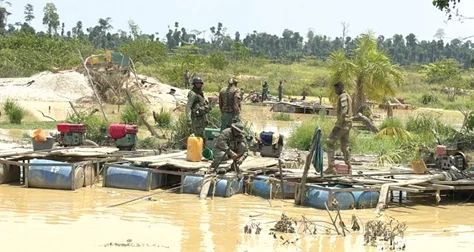
In a sweeping operation targeting illegal mining activities in the Ashanti Region, a rapid response team from the Forestry Commission has arrested 23 individuals in the Oda River Forest Reserve—18 of whom claim they were displaced by the ongoing Bawku conflict in the Upper East Region.
The dawn-to-dusk swoop, conducted last Thursday, forms part of intensified efforts to curb the devastating impact of galamsey on the Oda River and its tributaries. Among those apprehended, four are women, all identified as indigenes of Bawku who fled the protracted ethnic conflict in search of alternative livelihoods.
Ernest Adofo, Deputy Ashanti Regional Manager of the Forest Services Division in charge of the Bekwai Forest District, expressed concern over the emerging trend of conflict-displaced persons turning to illegal mining.
“I have interacted with many of the arrested illegal miners, and they confirmed to me that they left Bawku because of the conflict in the area and were engaged in galamsey to make a living,” Mr Adofo told the Daily Graphic.
He disclosed that other suspects hailed from Zebilla, Bolgatanga, Nalerigu, and neighbouring Burkina Faso.
Operations Destroy 43 Camps, Seize Equipment
The 50-member joint task force, comprising forest guards and officials from the Bekwai Forest District, destroyed 43 makeshift camps operated by the illegal miners along the Oda River during the operation.
Additionally, the team dismantled 82 changfans—local mining devices—and 77 water pumping machines used to extract water from the river for mining activities. Twenty-one motorbikes and a tricycle were also seized.
Mr Adofo noted that while previous efforts had successfully driven out excavator operators from the forest reserve, the increasing use of changfans and pumping machines presented a new challenge.
“We have been able to deal with the use of excavators in the Oda River Forest Reserve, but the worrying trend now is the increasing use of changfans and water pumping machines to pollute the Oda River,” he said.
He added that many illegal miners spotted during the operation managed to evade arrest, underscoring the scale of the challenge facing enforcement authorities.
Environmental Toll
The operation comes on the heels of alarming findings from a national satellite remote-sensing study released by the Forestry Commission on February 24, 2026. The report revealed that 8,923.8 hectares of Ghana’s forest reserves—equivalent to 12,500 FIFA-standard football fields—have been severely degraded by illegal mining activities as of December 31, 2024.
The Oda River Forest Reserve was identified as the most affected, with 2,654.8 hectares of land impacted—more than any other protected area in the country. Upper Wassa Forest Reserve (1,660.4 hectares) and Apamprama Forest Reserve (1,366.7 hectares) followed on the list of most devastated reserves.
The study covered 45 forest reserves and one national park, painting a grim picture of the environmental destruction wrought by galamsey operations across the country.
Calls for Sustained Action
Environmental advocates have repeatedly called for stronger enforcement and alternative livelihood programmes to address the root causes of illegal mining, including poverty and displacement.
The link between the Bawku conflict and the influx of migrants into forest reserves highlights the interconnected nature of Ghana’s security and environmental challenges. The Bawku conflict, which has claimed dozens of lives and displaced hundreds over the years, continues to have ripple effects far beyond the Upper East Region.
Mr Adofo reaffirmed the Forestry Commission’s commitment to protecting the nation’s forest reserves, urging the public to support efforts to preserve Ghana’s natural heritage.
“We will not relent in our efforts to clamp down on illegal mining activities. The destruction of our water bodies and forest reserves affects everyone, and we must all play a role in safeguarding them,” he said.
The suspects are expected to face prosecution, while investigations continue into the broader networks facilitating illegal mining in protected areas.


