



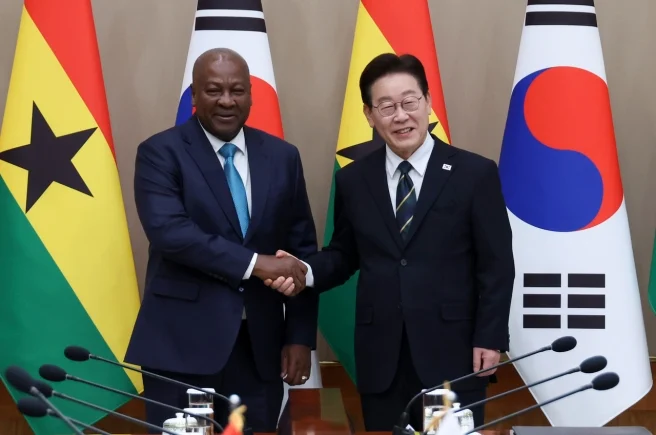
President John Dramani Mahama and South Korean President Lee Jae-myung have concluded high-level summit talks in Seoul, resulting in a series of landmark agreements aimed at deepening bilateral cooperation in maritime security, climate action, and digital innovation.
The talks, held Wednesday at the South Korean presidential office, formalized several key areas of collaboration during President Mahama’s ongoing working visit to the Asian nation.
Strengthening Security in the Gulf of Guinea
A cornerstone of the discussions was the signing of a Memorandum of Understanding (MoU) between the Korea Coast Guard and the Ghana Navy. The agreement is designed to bolster maritime safety and security through joint training programs, educational exchanges, and intelligence sharing aimed at combating transnational crimes such as piracy, arms trafficking, and drug smuggling. It also establishes a framework for collaborative search-and-rescue operations.
South Korean officials emphasized that the pact is expected to enhance stability in the Gulf of Guinea, a region long identified as one of the world’s most piracy-prone zones. The security of these waters is of strategic importance to international shipping, including South Korean commercial fleets and energy carriers. The agreement builds on existing defense ties, which were highlighted by the kidnapping of three South Korean nationals by pirates near Ghana in 2018 and the transfer of a decommissioned patrol boat to Ghana in 2010.
Advancing Climate Goals and Digital Innovation
Beyond security, the two governments finalized a framework agreement on climate change cooperation. The deal paves the way for joint climate initiatives, scientific research, and technology exchange, specifically utilizing emissions reduction mechanisms under the Paris Agreement. Officials in Seoul noted that the arrangement creates a legal basis for both nations to pursue their nationally determined contributions (NDCs) through cooperative approaches, such as the transfer of carbon reduction outcomes known as Internationally Transferred Mitigation Outcomes (ITMOs) under Article 6.2 of the accord.
In a move to future-proof the partnership, the leaders also signed an additional MoU covering cooperation in digital technology, innovation, and emerging sectors like artificial intelligence (AI).
Symbolism and Substance in Cultural Exchange
The focus on maritime cooperation was symbolically reinforced by the gifts presented to the Ghanaian leader. Among them was a traditional Korean folding screen depicting “Sugun Joryeondo,” a folk painting from the Joseon dynasty illustrating a naval warship formation.
The maritime theme will continue later in the visit, as President Mahama is scheduled to travel to Ulsan to attend the naming ceremony of a vessel at the HD Hyundai Heavy Industries shipyard. The vessel is believed to be intended for transporting liquefied petroleum gas (LPG) to Ghana.
President Mahama was also presented with a Samsung Galaxy S26 Ultra smartphone, described by South Korean officials as a symbol of the nation’s technological capability and industrial competitiveness.
Adding a uniquely symbolic cultural element to the welcome, the presidential office included Lotte’s famous “Ghana Chocolate” among the gifts. The product, widely popular in South Korea, is made with over 80% cocoa beans sourced from Ghana. Specially designed boxes bearing the national flags of both countries and President Mahama’s name were placed at his accommodation, highlighting the deep economic synergy between the two nations.
President Mahama’s visit underscores a mutual commitment by both countries to expand partnerships in strategic sectors, leveraging South Korean technology and Ghanaian resources for mutual growth and security.


