



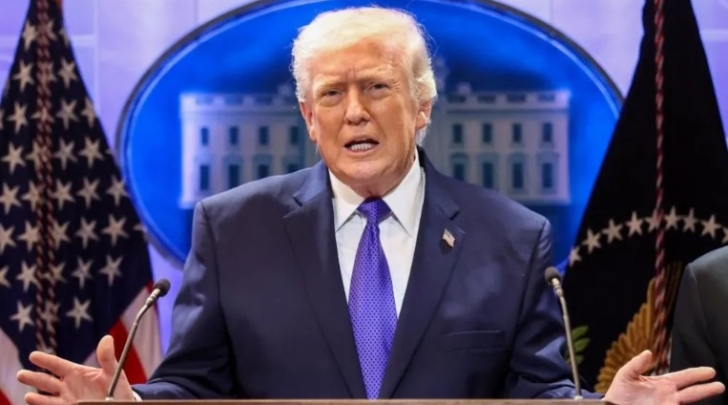
Global oil prices experienced a sharp decline and stock markets rebounded strongly on Tuesday following remarks by US President Donald Trump suggesting that the war in Iran is nearing its conclusion.
Speaking to reporters in Florida on Monday, President Trump indicated that the military action was always intended to be limited. “We took a little excursion because we felt we had to do that to get rid of some evil. Then, I think you’ll see it’s going to be a short-term excursion,” he said, adding that he believes “the war is very complete, pretty much.”
The comments provided immediate relief to jittery financial markets, which had been rattled by fears of a prolonged conflict disrupting global energy supplies. London’s FTSE 100 index opened 1.3% higher, while Asian markets closed sharply up. Japan’s Nikkei 225 gained 2.9%, recovering some of the previous session’s steep losses, and South Korea’s Kospi surged 5.4%.
The price of Brent crude, the international benchmark, fell below $84 a barrel in Asian trading—a dramatic drop from Monday’s peak of nearly $120. It later stabilised to trade around $93.76. US West Texas Intermediate (WTI) crude also fell 4% to $90.96 a barrel.
Despite the pullback, analysts warn that the energy market remains highly volatile. “The fall in oil prices on Tuesday has given traders a moment to exhale, but energy markets remain in a state of total tug-of-war,” said Alberto Bellorin from oil and gas investment firm InterCapital Energy. He noted that trading will “remain incredibly twitchy,” with prices likely to spike again if the conflict escalates.
Strait of Hormuz Tensions Remain a Flashpoint
While expressing optimism about an end to the war, President Trump issued a stark warning to Iran on social media, vowing a massive retaliation if Tehran moves to block the Strait of Hormuz. “If Iran does anything that stops the flow of Oil within the Strait of Hormuz, they will be hit by the United States of America TWENTY TIMES HARDER than they have been hit thus far,” he posted.
The warning drew an immediate and defiant response from Iran’s Islamic Revolutionary Guard Corps, which stated that “in response to Trump’s nonsense,” the country’s armed forces will “not allow the export of a single liter of oil from the region.”
The Strait of Hormuz is a critical chokepoint for the global energy market, through which about a fifth of the world’s oil passes. Park Kee Hyun from the S. Rajaratnam School of International Studies pointed out that despite the latest drop, prices are still about 20% higher than before the airstrikes began just over a week ago. “Prices will remain volatile,” he said, as shipping firms will continue to charge a premium to account for the risk of the situation worsening.
G7 Monitors Situation
The volatile situation has sparked international diplomatic efforts. G7 nations have stated they are ready to take “necessary measures” to address global energy supply concerns. A meeting between G7 leaders and the International Energy Agency (IEA) discussed the potential release of oil from strategic stockpiles, though a final decision has yet to be made.
UK Chancellor Rachel Reeves confirmed that Britain is advocating for immediate de-escalation. “I stand ready to support a co-ordinated release of collective IEA oil reserves,” she said on Monday.
For now, the market remains fixated on the battlefield, weighing the prospect of peace against the threat of a new, more dangerous phase of the conflict.


