



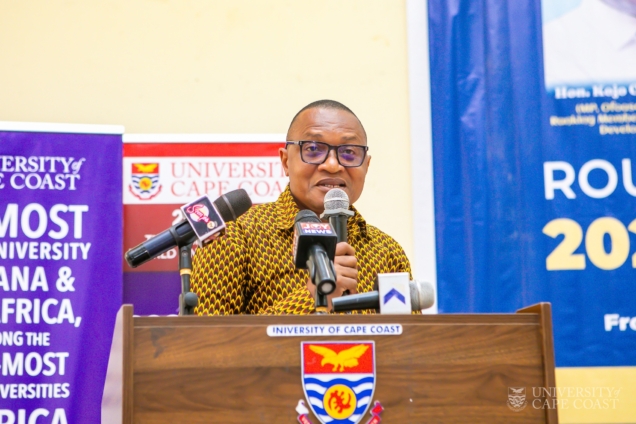
Ghana’s fragile economic recovery faces a serious external shock as escalating military conflict in the Middle East threatens to reverse the country’s hard-won single-digit inflation, a University of Cape Coast economist has warned.
Professor William Brafu-Insaidoo, speaking on Channel One Newsroom on Saturday, cautioned that the closure of the Strait of Hormuz—a critical passageway for nearly one-third of the world’s seaborne oil—will inevitably drive up domestic fuel prices and reignite inflationary pressures across the Ghanaian economy.
“The other angle we can look at this is in terms of global oil prices. Higher global oil prices will immediately increase domestic fuel and transport costs,” Prof. Brafu-Insaidoo explained. “The trickle-down effect is that once fuel and transport costs go up, it affects almost every other economic activity.”
The warning follows a dramatic escalation over the weekend, with U.S. and Israeli strikes targeting Iranian leadership and Iran’s Revolutionary Guards subsequently shutting down the Strait of Hormuz to all vessel traffic. Israeli Prime Minister Benjamin Netanyahu has further confirmed that Israeli forces destroyed a compound belonging to Iran’s Supreme Leader, Ali Khamenei.
Cost-Push Inflation Looms
The economist expressed particular concern about the contagion effect of rising transport costs on essential goods. With the vast majority of food, medicine, and manufactured products transported by road across Ghana, any increase at the pump rapidly translates into higher prices for consumers.
This cost-push inflation dynamic threatens to dismantle the progress reflected in the Consumer Price Index—a key metric that the Bank of Ghana and Finance Ministry have celebrated as evidence of economic recovery in early 2026.
“When that is factored into other activities, the fact that a number of essential goods are transported and it will cost more to transport them, then obviously it is going to push up inflation,” Prof. Brafu-Insaidoo said. “What we normally call cost-push inflation. And this is likely, if we are not careful, it can derail Ghana’s recent success in bringing inflation down to single digits.”
Government Action Urged
With international calls for restraint mounting amid fears of broader regional conflagration, the economist urged Ghanaian authorities to prepare contingency measures to shield citizens from the anticipated fuel price hikes.
The single-digit inflation milestone—achieved after months of aggressive monetary policy and fiscal consolidation—now appears increasingly vulnerable to geopolitical developments thousands of miles away in the Persian Gulf.
As the situation continues to evolve, all eyes will be on government’s response to what economists describe as a classic external shock threatening domestic stability.


