



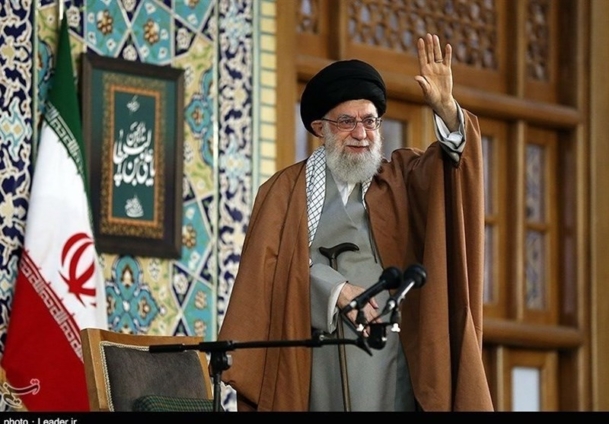
Iran’s Supreme Leader Ayatollah Ali Khamenei, 86, was killed in a coordinated American-Israeli military operation targeting senior Iranian leadership, state media confirmed Saturday, plunging the Middle East into a new and volatile chapter of conflict.
The Iranian government has announced 40 days of national mourning following the death of the country’s highest authority, who had ruled for decades. The attack, which Iran’s Foreign Ministry condemned as a “gross violation” of national sovereignty, struck both military and civilian targets across the country.
According to state media, the strikes began after sunrise in Tehran, with huge explosions rocking the capital. Video footage verified by news agencies showed massive plumes of smoke rising over the city. Communications were disrupted shortly after the initial wave of attacks.
The Iranian Red Crescent Society reported that more than 200 people were killed in strikes across Iran. In a particularly devastating development, the local prosecutor’s office confirmed that an airstrike hit a girls’ primary school in southern Iran, killing at least 85 children. Officials stated that additional students remain buried under the rubble. Saturday marks the beginning of the Iranian school and work week.
In a statement on Truth Social, former President Donald Trump confirmed the operation, asserting that Khamenei had been killed with U.S. support working in close coordination with Israel.
“He was unable to avoid our Intelligence and Highly Sophisticated Tracking Systems,” Trump posted. “The heavy and pinpoint bombing, however, will continue, uninterrupted throughout the week or, as long as necessary to achieve our objective of PEACE THROUGHOUT THE MIDDLE EAST AND, INDEED, THE WORLD!”
A source briefed on the strike confirmed to NPR that Khamenei was killed by an Israeli strike, speaking on condition of anonymity due to lack of authorization to discuss the matter publicly.
Senior Leadership Decimated
Israel’s military announced that top Iranian security officials were among those killed, including the defense minister, the commander of the Revolutionary Guard Corps, and the secretary of the Iranian Security Council, a close adviser to Khamenei. Iran has not independently confirmed these deaths.
The Israel Defense Forces described the operation, involving approximately 200 fighter jets striking about 500 targets in western and central Iran, as the largest air force operation in the country’s history. Targets included aerial defense systems and missile launchers.
An Israeli military official told reporters that U.S. and Israeli forces spent months building an extensive target bank, waiting for the optimal moment when senior Iranian officials would be gathered. Three separate meetings of senior leadership were struck simultaneously Saturday morning, the official said.
Regional Conflict Expands
Iran launched retaliatory missile and drone strikes, spreading the conflict across the region. Air raid sirens wailed in Israel as the country came under attack. Multiple Gulf nations reported Iranian strikes, including Saudi Arabia, the United Arab Emirates, Qatar, Bahrain, and Kuwait.
Bahrain’s government confirmed that an Iranian airstrike hit the U.S. naval base hosting the U.S. Fifth Fleet. The UAE reported intercepting Iranian missiles, with shrapnel from one strike killing a national of an unspecified Asian country in Abu Dhabi.
Jordan, which hosts major U.S. military bases, reported downing 49 drones and ballistic missiles threatening its territory.
Israel declared a 48-hour state of emergency nationwide, closed its airspace to all passenger flights, and activated civil defense protocols. Hospitals in central Israel began moving operations to underground fortified compounds as missile interceptions lit the sky above Tel Aviv.
U.S. Justification and Objectives
Capt. Tim Hawkins, a spokesperson for U.S. Central Command, addressed reports of civilian casualties, stating: “We take these reports seriously and are looking into them. The protection of civilians is of utmost importance, and we will continue to take all precautions available to minimize the risk of unintended harm. Unlike Iran, we have never — and will never — target civilians.”
In an eight-minute video posted on Truth Social, Trump characterized the operation as defensive: “Our objective is to defend the American people by eliminating imminent threats from the Iranian regime, a vicious group of very hard, terrible people.”
The president claimed Iran was rebuilding its nuclear program, despite International Atomic Energy Agency monitors and nuclear experts stating there is no evidence Iran has resumed uranium enrichment.
Speaking directly to the Iranian people, Trump suggested regime change as an objective: “When we are finished, take over your government. It will be yours to take. This will be, probably, your only chance for generations.”
International Response
United Nations Secretary-General António Guterres condemned the strikes during an emergency Security Council meeting, warning of grave threats to international peace and security.
“We are witnessing a grave threat to international peace and security. Military action carries the risk of igniting a chain of events that no one can control in the most volatile region of the world,” Guterres said. “Let me be clear: There is no viable alternative to the peaceful settlement of international disputes.”
White House Press Secretary Karoline Leavitt confirmed Saturday that the president had spoken with leaders of Qatar, Saudi Arabia, UAE, and NATO Secretary General Mark Rutte.
On the Ground in Iran
A Tehran resident who spoke with reporters before communications were cut described panic in the streets: “People were panicking and trying to get to their homes. Children are running out of school.”
Another resident reported that internal security forces were flooding residential neighborhoods. “Many of them are on the streets on motorbikes, showing off their guns. They want to create fear.”
Military analysts note that with no indication of U.S. ground troop deployment, toppling the Iranian government through air power alone remains extremely challenging. The Iranian security forces brutally suppressed mass protests just last month, with the U.S.-based Human Rights Activist News Agency reporting more than 7,000 killed.
The coming days will determine whether Iran’s leadership can maintain control or faces a domestic uprising as the nation begins its 40-day mourning period amid ongoing military operations and regional volatility.


