



As tensions escalate in the Middle East, a recent threat from Iran’s Supreme Leader to sink a U.S. warship has raised eyebrows among military analysts. But while the rhetoric is fiery, experts say the reality of crippling—let alone sinking—a nuclear-powered supercarrier is a feat far beyond Tehran’s current capabilities.
In a post on X earlier this month, Ayatollah Ali Khamenei issued a direct warning to the United States. “The Americans constantly say that they’ve sent a warship toward Iran,” he wrote. “Of course, a warship is a dangerous piece of military hardware. However, more dangerous than that warship is the weapon that can send that warship to the bottom of the sea.”
While the Supreme Leader did not specify the weapon, speculation has focused on Iran’s reported interest in acquiring Chinese-made CM-302 supersonic anti-ship missiles. With a range of approximately 180 miles and low-altitude flight capabilities designed to evade defenses, such a weapon would pose a legitimate threat. However, analysts caution that acquiring the missile is one thing; successfully employing it against a U.S. carrier is another entirely.
A Floating Fortress
Modern U.S. aircraft carriers are among the most resilient warships ever built. The last American carrier sunk in combat was the USS Bismarck Sea, lost to a Japanese kamikaze attack during the Battle of Iwo Jima in February 1945.
“Modern aircraft carriers are far larger and more resilient than their World War II kin,” noted Dr. Robert Farley, a senior lecturer at the University of Kentucky’s Patterson School of Diplomacy and International Commerce. “CVN-78 is 100,000 tons, some 150% the size of the largest WWII carrier. All other things equal, larger ships are more survivable than smaller ships.”
That vessel, the USS Gerald R. Ford, is currently en route to the Middle East, joining the Nimitz-class USS Abraham Lincoln already operating in the region. These ships are not solitary targets. They are the centerpiece of a Carrier Strike Group, a layered defensive bubble that includes Aegis-equipped destroyers and cruisers, attack submarines, and a combat air patrol of fighter jets ready to intercept threats before they get within range.
“A U.S. supercarrier is built to take punishment and keep fighting,” added Irina Tsukerman, president of threat assessment firm Scarab Rising. “The U.S. Navy also surrounds carriers with layers of defense: Aegis destroyers and cruisers, aircraft on combat air patrol, electronic warfare, decoys, and point defenses.”
Even if a missile managed to penetrate that shield, Farley noted that modern ordnance is designed for “soft” targets, not the heavily compartmentalized and reinforced hull of a supercarrier.
The Ghost of the USS America
In online discussions, many have pointed to the 2005 sinking of the decommissioned USS America as evidence of a carrier’s toughness. During that live-fire exercise, the ship absorbed weeks of punishment before being deliberately scuttled with internal explosives.
However, experts caution against reading too much into that event. The USS America was already in poor material condition, there were no damage control crews fighting to save her, and the test was designed to gather data, not simulate a real-world attack.
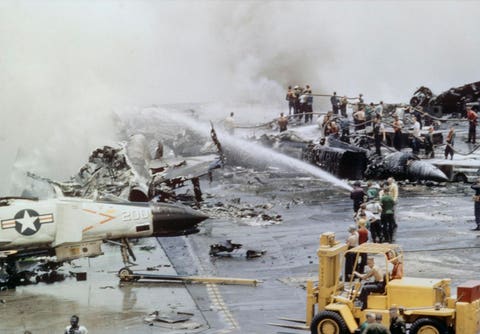
Indeed, the greatest asset in a carrier’s survivability is its crew. History provides stark examples of what happens when things go wrong. In the 1960s, three different carriers—the USS Oriskany, USS Forrestal, and USS Enterprise—suffered devastating fires and explosions from accidents involving munitions and fuel. While all three survived, the human and material cost was staggering: hundreds of sailors killed and injured, and hundreds of millions of dollars in damage.
The “Mission Kill” Scenario
This history underscores a critical point: Iran does not necessarily need to sink a carrier to achieve a strategic victory.
“The real concern is more that an airstrike could inflict sufficient damage on the flight deck and on hangar facilities to achieve a ‘mission kill,'” Farley explained. A missile strike could destroy catapult systems, arrestor gear, or communications equipment, making the carrier incapable of conducting flight operations and effectively neutralizing its offensive power until it can limp back to port for extensive repairs.
Such an outcome would be a political and psychological victory for Tehran.
“The U.S. Navy can absorb losses, but American politics reacts instantaneously to symbolic damage,” Tsukerman said. A single successful impact, even a non-lethal one, would shift the global narrative from “Iran is contained” to “U.S. forces are vulnerable.” This would instantly strengthen Iran’s deterrence posture and provide invaluable intelligence.
“It pressures Washington to choose between escalation and restraint under public scrutiny,” she warned. Furthermore, a probing attack, even a failed one, reveals U.S. defensive protocols—what gets shot first, what gets jammed, how the battlespace is organized. “It’s not just Iran that’s paying attention. Its proxies, as well as China and Russia, learn by watching. That intelligence value alone makes an ‘attempt’ useful to Iran.”
A High-Risk Gamble
For Iran, the strategy appears to be one of calibrated pressure. By threatening a carrier, it can raise the stakes and project strength without necessarily inviting regime-ending retaliation.
“An attack on a carrier or a serious attempt becomes a trigger for punishing retaliation,” Tsukerman acknowledged. “Iran accepts that risk because it believes it can manage escalation by controlling tempo and ambiguity… enough to hurt, enough to warn, sufficient to claim victory, not so much that they invite regime-threatening retaliation.”


