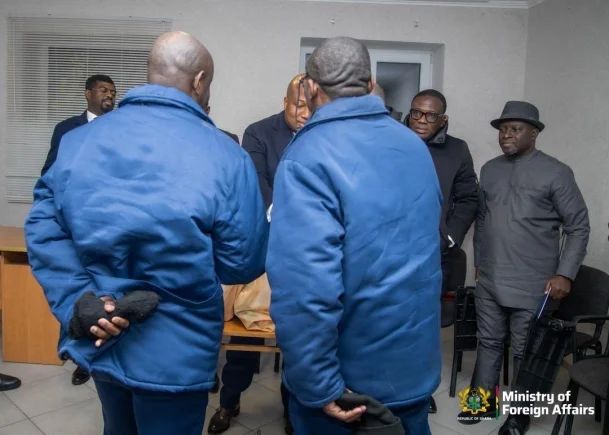
In a dramatic turn of events that underscores the global reach of the conflict in Eastern Europe, two Ghanaian nationals being held as prisoners of war in Ukraine have publicly apologized for their role in the fighting, describing their recruitment as a grave mistake that has tarnished their nation’s peaceful image.
The two men, identified only by the pseudonyms Kojo and Kofi to protect their identities, made the emotional plea during a clandestine visit to their detention facility by a high-level Ghanaian government delegation. The delegation, led by Ghana’s Minister of Foreign Affairs, Samuel Okudzeto Ablakwa, arrived at the undisclosed location shortly after midnight on Thursday.
A Remorseful Plea for Clemency
Speaking under the watch of their Ukrainian captors, the captives expressed deep regret, acknowledging the damage caused to Ghana’s international standing. They issued a direct appeal for forgiveness to Ghanaian President John Dramani Mahama, Ukrainian President Volodymyr Zelenskyy, and the citizens of both nations.
“We are very sorry for what we did. We know people all over the world know Ghana as a peaceful country with peace-loving people, but we have stained that status,” said Kojo, a father of one, his voice heavy with remorse. “We are not proud of what we did, and we ask Ghanaians and Ukrainians for forgiveness.”
Kofi, his compatriot, vowed to dedicate his life to warning other young Africans against the perils of the conflict if granted freedom. “We want our families to know we are alive,” he added. “We ask them to continue to remember us in their prayers.”
The Lure of Money and the Reality of War
The two men detailed harrowing accounts of how they were ensnared into the conflict, painting a picture of a sophisticated network preying on economic vulnerability.
Kojo, a former university student, recounted that he was lured to join the Russian forces in 2024 to pay his tuition fees. He was promised a signing bonus of 1.9 million Russian roubles and a monthly salary of 200,000 roubles. Initially told he would serve as a non-combatant fire rescue officer, he was later deployed to the front lines against his will. He claims the money is held in a Russian bank but has brought him little solace, aside from sending 500,000 roubles home to support an orphanage in Kumasi.
Kojo described surviving an attack that killed his entire unit, only to be captured by Ukrainian forces. He now carries shrapnel from the blast in his body, causing him persistent pain.
Kofi, a graphic designer by trade, told a different story of coercion. He was recruited by a Russian police officer after overstaying his visa. For eight months, he was kept away from combat, but was eventually deployed to the front lines after a change in command. Horrified by the death of his comrades, he fled the battlefield and surrendered to Ukrainian soldiers.
A Web of Recruitment and Broken Promises
The prisoners revealed that their cases are not isolated. They estimated that an agent recruited over ten Ghanaians at the time of their training, promising legitimate work before tricking them into signing military contracts. They alleged that recruitment into the Russian army has become a lucrative business, with agents taking a 30 per cent cut of each African recruit’s salary.
Ukrainian officials briefed the Ghanaian delegation, alleging that Russia has recruited a staggering 1,785 individuals from 36 African countries, including Ghana. The detention facility currently holds prisoners from Nigeria, Egypt, Burundi, Algeria, Morocco, and Uganda, confirming the widespread nature of the recruitment drive.
Government Pledges Action and Forgiveness
In a poignant moment, Foreign Minister Ablakwa conveyed the government’s official position of forgiveness and outlined ongoing efforts to secure the men’s release.
“President Mahama says I should tell you that he has forgiven you. The people of Ghana have also forgiven you,” Mr. Ablakwa told the captives. “We are committed to working with the Ukrainian officials for your release. We have discussed this with President Zelenskyy, but we still have some paperwork to do.”
The Minister stated that the government hopes to secure their release soon, with a plan for their rehabilitation and reintegration into society. He emphasized their future role as “ambassadors for peace” to combat the criminal networks exploiting vulnerable youth.
Mr. Ablakwa also issued a stark warning to young Ghanaians seeking opportunities abroad, urging them to exercise extreme caution and conduct thorough background checks on any job offers. He vowed that the government would take decisive action to dismantle the syndicates of agents endangering the lives of Ghanaians by sending them to foreign battlefields.