



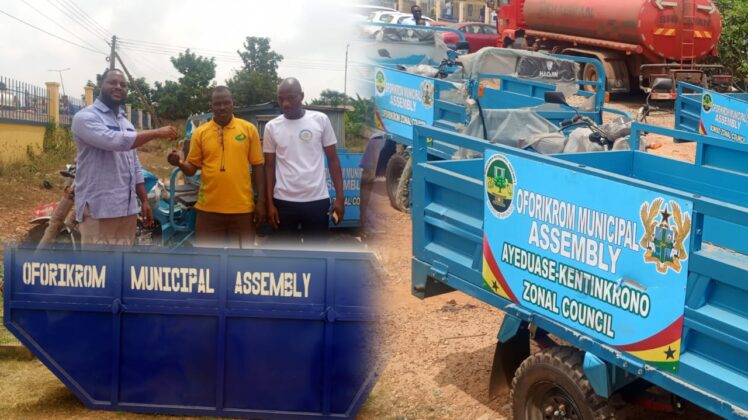
In a major push to combat poor sanitation and improve waste management, the Oforikrom Municipal Assembly has commissioned new equipment and announced plans to employ nearly 100 residents to keep the municipality clean.
The Assembly has taken delivery of three skip containers and four branded tricycles, which were officially handed over on Wednesday. The equipment is designed to bolster waste collection across the municipality’s four zonal councils: Ayeduase-Kentinkron, Ayigya, Bonso, and Oforikrom. The tricycles will facilitate household refuse collection, while the containers will serve as central waste storage and transfer points.
Speaking at the handover ceremony, the Municipal Chief Executive (MCE), Ahmed Anwel Sadat, emphasized that the initiative is a direct response to the government’s priority on environmental cleanliness. He noted that the equipment, funded by the Ministry of Local Government, is crucial to tackling the persistent issue of indiscriminate dumping.
“All the old skip containers have been damaged, which hindered our sanitation efforts,” Mr. Sadat stated. “We are expecting two more containers soon, and we have made provisions to procure an additional ten in our mid-year budget review. Sanitation is a matter of life, health, and leadership. It is our collective responsibility to confront these challenges head-on.”
Addressing the Employment Gap
Mr. Sadat further revealed that the Assembly is finalizing a public-private partnership with a waste management company to enhance operational efficiency. He announced that the contract, expected to be signed by the end of March, will also create direct employment for the youth.
“Oforikom is a large municipality, and our sanitation efforts were impacted following the government’s termination of Zoomlion’s contract,” the MCE explained. “To address this gap, we are in the process of recruiting about 90 people from the municipality to serve as sweepers across the various communities.”
A Call for Community Stewardship
The zonal council leaders, led by Hopeson and Kenneth Owusu Bediako, received the equipment on behalf of their communities and pledged to ensure its longevity. They appealed to residents to view the assets as a communal resource rather than a political tool.
“The zonal councils have guidelines in place to regulate the use of this equipment, and we expect it to serve the community for at least five years,” they assured. “These resources are for community use. Groups or individuals planning clean-up exercises should contact their Assembly Members to access them.”
They urged market operators, transport unions, and all residents to use the facilities responsibly and to stop practices that contribute to environmental pollution, stressing that the success of the Assembly’s drive depends on full public cooperation.


