



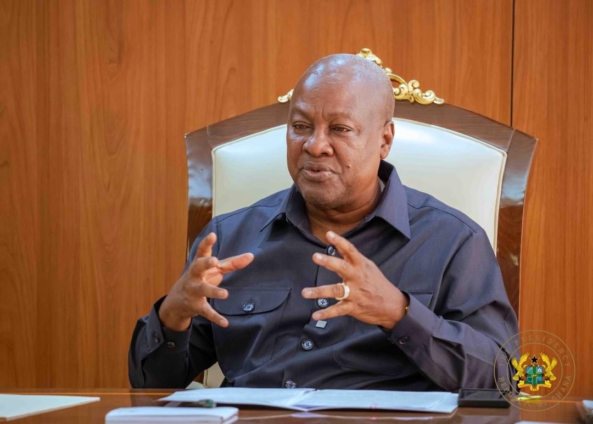
President John Dramani Mahama has declared that Ghana possesses the capacity to supply the entire West African sub-region with steel, provided the nation succeeds in building a robust and competitive domestic steel industry.
The President made these remarks on Friday, February 20, during the commissioning of the B5 Plus Limited Steel Manufacturing Plant at Prampram. He laid out an ambitious industrial vision aimed at positioning Ghana as a regional powerhouse in steel production.
Central to this strategy is a deliberate shift up the industrial value chain. President Mahama emphasized a move away from exporting raw scrap materials towards prioritizing finished and semi-finished steel products.
“We are moving up the value chain. We’re exporting finished and semi-finished products, not raw scrap,” he stated.
The President connected the steel industry’s growth directly to the government’s flagship “Big Push” infrastructure programme. This initiative involves heavy investment in critical sectors such as roads and highways, railway modernization, bridges, energy transmission lines, affordable housing, and industrial parks.
“All these I have mentioned require iron and steel,” President Mahama noted. He highlighted the immense demand on the continent, stating, “Africa is projected to require over $100 billion annually in infrastructure development. West Africa alone faces significant infrastructure deficits.”
According to the President, a strong local steel industry would allow Ghana to capitalise on this demand. “If Ghana develops a strong steel base, we not only build our own roads and bridges, we will also supply steel to the whole sub-region. This is how infrastructure becomes industrial strategy,” he explained.
24-Hour Economy to Fuel Industrial Growth
President Mahama also underscored the critical role of the government’s 24-hour economy initiative, particularly for energy-intensive industries like steel manufacturing. He described the imminent signing of the 24-Hour Economy Authority Bill into law as a vital step for boosting industrial productivity, revealing that the B5 Plus Group is expected to be among the first companies to register under the programme.
“Steel production benefits from continuous operation to reduce energy wastage, improve efficiency, lower unit production costs, and maximise asset utilisation,” he said.
The President expressed confidence that with dedicated industrial tariff reforms, an improved grid, and expanding domestic gas supply, Ghanaian manufacturers could operate competitively around the clock. He disclosed that an amount of $110 million has been allocated in the 2026 budget to operationalise the initiative, signalling the government’s commitment to industrial transformation.
“When factories run three shifts instead of one, employment rises, productivity increases, and exports expand,” President Mahama added.
He concluded that a thriving steel industry, bolstered by strategic infrastructure investment and a shift to continuous production, would not only fortify Ghana’s economy but also firmly establish the nation as a key industrial supplier within the West African sub-region.


