



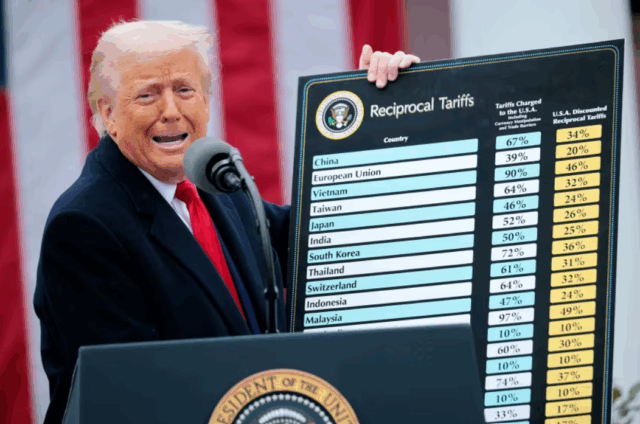
In a landmark decision on Friday, the U.S. Supreme Court dealt a significant blow to former President Donald Trump’s trade agenda, ruling that he overstepped his constitutional authority when he imposed sweeping tariffs on imports from around the world.
The 6-3 ruling invalidates a wide range of tariffs the Trump administration had justified under the International Emergency Economic Powers Act (IEEPA), a 1977 law designed to allow presidents to respond to national emergencies. The Court found that this law does not grant the executive branch the power to impose tariffs of unlimited scope and duration.
Chief Justice John Roberts, writing for the majority, emphasized the extraordinary nature of the president’s actions. “The president asserts the extraordinary power to unilaterally impose tariffs of unlimited amount, duration and scope,” Roberts wrote. He added that the administration “points to no statute” where Congress had authorized the use of IEEPA for such purposes, concluding, “we hold that IEEPA does not authorize the president to impose tariffs.”
The ruling, which saw the chief justice joined by the court’s three liberal justices as well as conservative Justices Neil Gorsuch and Amy Coney Barrett, is a rare legal setback for Trump since he began his second term in January. The White House had no immediate comment, though sources say a visibly angered Trump called the decision a “disgrace” during a meeting with governors and hinted at having a “backup plan.”
A Win for Businesses, Confusion for Treasury
The decision was met with relief from the business community, particularly small importers who had challenged the levies in court. Victor Schwartz, who runs the New York-based wine importer VOS Selections, praised the ruling. “These new tariffs were arbitrary, unpredictable, and bad business,” Schwartz said in a statement. “Thankfully, courts at every level recognized these duties for what they were: unconstitutional government overreach.”
The ruling directly overturns two major categories of Trump’s trade policy:
- “Reciprocal” Tariffs: The country-by-country tariffs, which ranged from a 10% baseline on most nations to 34% on goods from China.
- Fentanyl-Related Tariffs: The 25% tariffs imposed on certain goods from Canada, China, and Mexico, which the administration had justified as a measure to curb the flow of fentanyl.
While a victory for importers, the decision creates a complex and costly challenge for the U.S. Treasury. Companies that paid the now-invalidated tariffs may be eligible for refunds totaling billions of dollars. Advocacy groups, including the small-business coalition “We Pay the Tariffs,” are already demanding a swift resolution.
“Small businesses cannot afford to wait months or years while bureaucratic delays play out, nor can they afford expensive litigation just to recover money that was unlawfully collected from them in the first place,” said Dan Anthony, the group’s executive director.
In his dissenting opinion, Justice Brett Kavanaugh acknowledged the financial implications, noting the Court’s silence on the issue of refunds leaves a massive question mark hanging over the Treasury Department. “The Court says nothing today about whether, and if so how, the Government should go about returning the billions of dollars that it has collected from importers,” Kavanaugh wrote.
What Tariffs Remain?
Despite the sweeping nature of the decision, it does not dismantle the entirety of Trump’s protectionist trade agenda. Tariffs imposed on steel and aluminum, which were enacted using different legal authorities, remain in place. Furthermore, as Justice Kavanaugh noted in his dissent, the ruling is “not likely to greatly restrict Presidential tariff authority going forward,” as it is limited specifically to the use of IEEPA.
The case puts a spotlight on the “major questions doctrine,” a legal principle cited by Chief Justice Roberts, which holds that Congress must explicitly authorize policies with vast economic and political significance. While that specific part of the opinion did not command a majority, it signals the Court’s continued skepticism of unilateral executive action on matters of major national importance.


