



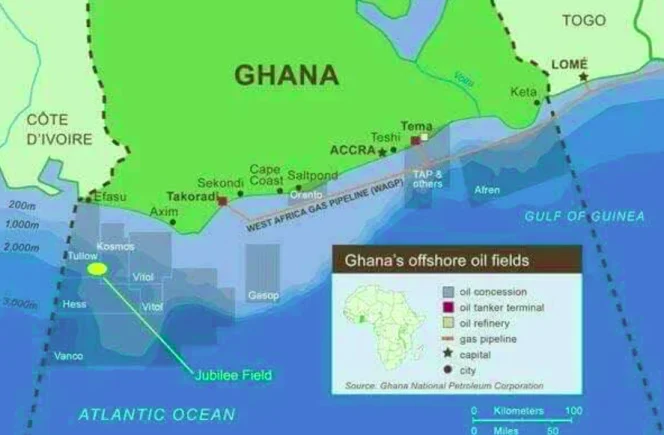
The Ghanaian government has formally triggered international arbitration proceedings against Togo in a decisive move to resolve a longstanding maritime boundary dispute that has strained bilateral relations for nearly a decade.
In an official statement released on Friday, the Presidency Communications Office confirmed that Accra has notified Lomé of its intention to seek a binding delimitation of the contested maritime border under the auspices of the United Nations Convention on the Law of the Sea (UNCLOS).
“The Government of Ghana has served the Government of Togo with notice of its decision that the maritime boundary between Ghana and Togo be delimited by recourse to international arbitration under the United Nations Convention on the Law of the Sea (UNCLOS),” the statement read.
The decision to seek arbitration follows eight years of fruitless diplomatic negotiations aimed at finding a mutually agreeable solution. According to the presidency, the persistence of the dispute has begun to impact operational relations between state institutions of the two neighboring West African states.
“This follows attempts at negotiating a boundary which have gone on for the past eight years but have not resulted in an agreed outcome,” the statement noted.
De-escalation Through Legal Means
While the statement did not specify the exact points of contention or recent incidents that prompted the move, the government emphasized that the arbitration is intended to prevent further deterioration of ties.
“Ghana has taken this step in order to avoid an escalation of incidents that have created tensions between some of our institutions and to promote an amicable resolution, thereby contributing to the continued good relations between our two countries,” the presidency explained.
The dispute, which dates back to at least 2017, centers on competing claims over offshore zones believed to be rich in oil and gas resources. Tensions previously flared when Togolese authorities halted seismic survey vessels operated by Ghana from conducting exploration activities in waters approaching its territory.
Strategic Implications
The decision to invoke UNCLOS arbitration signals Ghana’s preference for a legally binding resolution over prolonged political negotiations. The international treaty provides a recognized framework for resolving disputes over maritime boundaries, territorial waters, and resource rights, and has been used by coastal states worldwide to secure definitive rulings.
Maritime boundaries are particularly sensitive in the Gulf of Guinea, where offshore hydrocarbon deposits and rich fishing grounds carry significant economic implications for both nations.
The move comes six years after Ghana successfully resolved a similar maritime boundary dispute with Côte d’Ivoire through international arbitration, a case that reaffirmed Ghana’s sovereignty over its oil-rich Western Basin.
Next Steps
With the formal notification served, the coming months will likely see the constitution of an arbitral tribunal and the submission of legal arguments by both states. Such proceedings typically take several years to reach a final award.
The government reiterated its commitment to maintaining cordial relations with Togo throughout the process, expressing hope that arbitration would ultimately strengthen, rather than undermine, the longstanding friendship between the two countries.


