



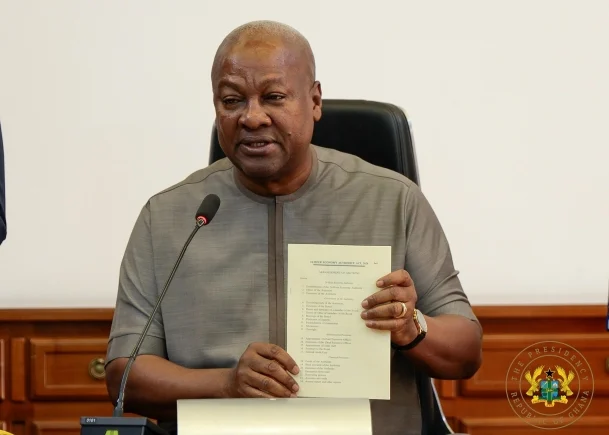
President John Dramani Mahama has officially signed the 24-Hour Economy Authority Bill, 2025, into law, transforming a key campaign promise into a legislative framework designed to restructure the country’s economic operations.
The signing ceremony took place on Thursday at the Jubilee House, just before the 13th Cabinet meeting, providing legal backing for the establishment of a dedicated authority to oversee the implementation of the round-the-clock economic model.
Addressing his Cabinet colleagues immediately after appending his signature, the President described the moment as a long-awaited step in the nation’s reform agenda.
“Colleagues, I just appended my signature to give assent to the 24-Hour Authority Bill. This Bill, which Ghanaians have been waiting for, was one of our flagship strategies for economic transformation,” he announced.
President Mahama explained that the time taken to finalize the bill was a result of rigorous scrutiny to ensure the policy framework was both legally sound and practical for implementation. With the legal hurdles cleared, he emphasized the need to shift focus from strategy to action.
“Now we must move from strategy to implementation. The business sector is waiting, Ghanaian investors are waiting, foreign investors are waiting,” the President stated. He noted that the investment community is particularly eager to understand the specific incentives that will accompany the policy. “They want to see the package of incentives that we can afford, so that they can invest more and expand productivity and also create more employment for our young people.”
What the Law Entails
The newly enacted legislation formally establishes the 24-Hour Economy Authority. This body will serve as the central coordinating agency responsible for driving the policy’s implementation. Its mandate includes aligning public and private sector initiatives, removing regulatory bottlenecks, and supporting the infrastructure needed to facilitate continuous economic activity.
The core objective of the 24-hour economy policy is to encourage businesses to operate in multiple shifts. This, according to government proponents, is expected to boost industrial output, stimulate both local and foreign investment, and significantly expand job opportunities, particularly for the nation’s youth.
Next Steps
With the bill now enshrined in law, government attention is expected to pivot toward the operationalization of the policy. Key stakeholders are awaiting the rollout of specific incentive packages, the identification of priority sectors, and the establishment of institutional coordination mechanisms required to translate the ambitious policy into measurable economic outcomes.


