



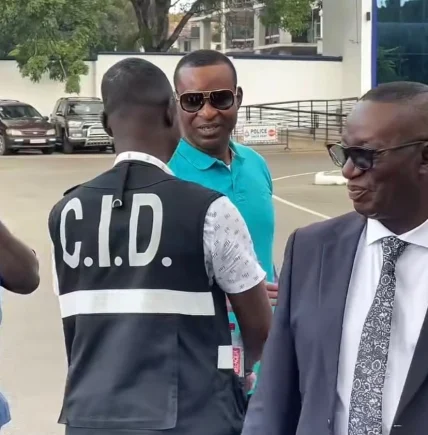
The High Court has been urged to acquit and discharge the Ashanti Regional Chairman of the New Patriotic Party (NPP), Bernard Antwi Boasiako, popularly known as Chairman Wontumi, over charges related to illegal mining activities on his concession.
Chairman Wontumi and his company, Akonta Mining Company Ltd, are facing six counts including permitting two individuals—Henry Okum and Michael Gyedu Ayisi—to mine on the company’s concession without prior ministerial approval, as well as facilitating unlicensed mining.
In a submission of no case filed on Tuesday, February 18, 2026, counsel for the accused, Andy Appiah-Kubi, argued that the Attorney-General’s Office had failed to provide sufficient evidence to compel his clients to open their defence.
“Having regard to the evidence adduced by the prosecution and the essential elements of the offences charged, it is respectfully submitted that the prosecution has woefully failed to establish a prima facie case against the accused persons on all six counts,” Appiah-Kubi submitted.
He described the prosecution’s case as suffering from “fundamental and fatal deficiencies,” both in the absence of evidence on essential elements and the poor quality and reliability of the evidence presented.
Prosecution’s Case
The prosecution called four witnesses, including Michael Gyedu Ayisi, who testified that he partnered with Henry Okum to operate on Akonta Mining Company Limited’s concession. Ayisi claimed Okum had informed him that Chairman Wontumi had granted them permission to mine on the site, and they continued operations until their arrest.
However, under cross-examination, Ayisi admitted he had never met or communicated directly with Chairman Wontumi. He also confirmed he did not hold a mining licence, had never applied for one, had no written agreement with the accused persons, and had not paid any fee for permission to mine.
Defence Argument
Appiah-Kubi contended that permitting individuals to mine on a concession did not amount to an assignment of mineral rights—a critical distinction in law.
“Permission is a licence or authorisation to do something on another person’s property without transferring any proprietary rights. An assignment, on the other hand, involves the transfer of proprietary rights themselves. The distinction is critical and well-established in law,” he submitted.
He argued that the prosecution’s failure to provide evidence of an assignment was not a minor or technical lapse but a fundamental failure to prove an essential element of the alleged offences.
On the charge of facilitating unlicensed mining, counsel submitted that the prosecution had failed to demonstrate any positive acts of facilitation by his clients.
“The prosecution must prove positive acts of facilitation, and it has failed to do so. The mere occurrence of unlicensed mining activities on a concession held by the accused does not establish that they purposely facilitated such operations,” he argued.
He further noted that the prosecution had not established that the accused persons had actual knowledge that Ayisi and Okum were operating without valid licences.
Next Steps
The prosecution, led by Deputy Attorney-General Justice Srem-Sai, is yet to file its response to the submission of no case.
The matter has been adjourned to March 10, 2026.
Legal Context
Under Section 173 of the Criminal and Other Offences (Procedure) Act, 1960 (Act 30), a submission of no case allows an accused person to argue that the prosecution has failed to establish a prima facie case requiring them to open their defence.
If the court upholds the submission, the accused persons are discharged. If it is dismissed, they will be required to open their defence.


