



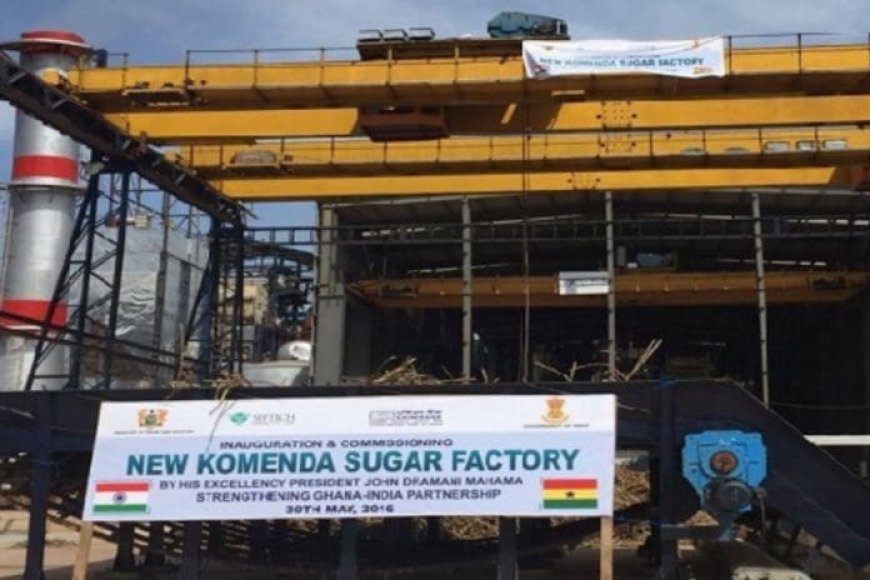
Ghana’s ambitious industrial dream has suffered another major setback as the Komenda Sugar Factory has been disconnected from the national electricity grid and water supply over unpaid utility bills.
Minister for Trade, Agribusiness and Industry, Elizabeth Ofosu-Adjare, revealed the development on the floor of Parliament on Tuesday, February 17, 2026. She confirmed that the Electricity Company of Ghana and the Ghana Water Company Limited took the drastic step after the facility accumulated significant arrears.
The disconnection highlights the severe operational and financial distress plaguing the factory. According to the Minister, the facility is crippled by substantial debt, decaying infrastructure, and a critical lack of maintenance and capital investment, all of which have repeatedly thwarted efforts to restart commercial production.
Government Seeks Private Investor to Revive Operations
In response to the crisis, the government has fast-tracked plans to bring in a strategic private investor. Minister Ofosu-Adjare stated that a transaction advisor will be engaged to repackage the factory and solicit a private partner, a move slated for the 2026 budget.
She assured Parliament that the outstanding utility debts, which she described as “worrisome,” would be resolved as part of the transition to private sector control.
“The factory has accumulated electricity bills that are worrisome. When we have the transaction adviser and the private sector operator, it will be part of the cost for the plant, so all of that will be taken care of,” she explained.
A Litany of Operational Failures
Since its commissioning in 2016, the facility has never undergone a major refurbishment. The Minister outlined a host of urgent mechanical failures, including critical generators and motors in desperate need of repair. A key component—the boiler’s top coil—must be completely replaced for the plant to function at full capacity.
Beyond the machinery, a persistent shortage of sugarcane remains the most fundamental barrier to revival. Farming communities that were expected to supply the factory have reportedly abandoned the effort, citing a lack of institutional support and unclear procurement agreements.
Unfulfilled Promise
Commissioned as a flagship project under Ghana’s agro-industrialisation agenda, the Komenda Sugar Factory was designed to process 1,250 metric tonnes of sugarcane daily, producing up to 150 metric tonnes of refined sugar.
At full capacity, it was projected to generate 80,000 direct and indirect jobs, transforming the local economy of Komenda in the Central Region and significantly reducing Ghana’s reliance on imported sugar.
Its continued underperformance has reignited debate over the viability of state-led industrial projects and raises serious questions about the country’s ability to achieve its goals of industrial transformation and food import substitution.


