

A commentary published by Graphic Online has called for the protection of Ghana’s cocoa farms to be placed at the centre of the national fight against illegal mining, warning that the destruction of cocoa-growing land poses an economic and environmental threat that outweighs the immediate value of extracted gold.
The opinion piece, authored by Benjamin Teye Larweh and published on October 24, 2026, argues that while the government pursues the formalisation of eligible artisanal and small-scale miners, a non-negotiable principle must guide policy: no economic activity should be permitted to destroy the agricultural assets and ecosystems upon which the country’s long-term prosperity depends .
New Law Provides Legal Foundation
The commentary anchors its argument in the Ghana Cocoa Board Act, 2026 (Act 1182), which President John Dramani Mahama assented to on August 26, 2026 . The law designates all cocoa farms as protected land, regardless of whether the land is stool, skin, family, private, or public property . It prohibits extractive or environmentally disruptive activities within 500 metres of a protected cocoa farm, and imposes penalties of 10 to 20 years’ imprisonment for illegal mining on cocoa land, alongside financial penalties calculated by reference to trees destroyed .
Larweh argues that the 500-metre buffer is significant because the risks associated with mining are not confined to the precise location of excavation. Excavation, erosion, altered drainage, and potential contamination can affect neighbouring farms and communities, meaning a protected farm must not exist only on paper .
Scale of Destruction
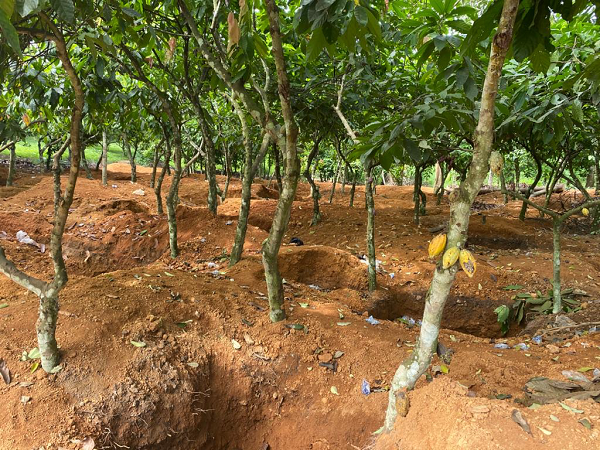
The commentary’s warnings come amid mounting evidence of galamsey’s toll on the cocoa sector. In July 2026, Samuel Asuman, Regional Manager of COCOBOD’s Western South Cocoa Health and Extension Division, reported that illegal mining had destroyed more than 100,000 acres of high-yield cocoa plantations across the Ashanti, Western, and Central regions, warning that without intervention the industry faced collapse . The encroachment was concentrated in areas COCOBOD had previously invested in rehabilitating, compounding losses beyond the immediate acreage cleared .
Ghana’s national cocoa output for the 2025/2026 season was projected at approximately 650,000 tonnes, down sharply from 1,047,385 tonnes recorded in 2021 . COCOBOD Chief Executive Dr. Randy Abbey has acknowledged that declining output has been linked to disease outbreaks, illegal mining, adverse weather, and financing constraints .
Formalisation Debate Intensifies
The commentary also intervenes in the ongoing controversy over GoldBod CEO Sammy Gyamfi’s remarks on formalising unlicensed miners. A viral social media video prompted accusations that Gyamfi had endorsed galamsey, allegations GoldBod has strongly rejected, describing the footage as selectively edited and taken from a March 2026 engagement with miners .
Larweh argues that formalisation must never be confused with permission to mine wherever an operator chooses. “An unlicensed operation does not become lawful simply because it is economically beneficial or located outside a forest reserve or water body,” he writes, adding that eligibility for formalisation must be assessed under the applicable legal framework, including restrictions governing protected cocoa farms .
The Ghana National Association of Small Scale Miners has also defended Gyamfi, stating that his remarks concerned registering and regularising eligible unlicensed miners whose operations do not affect water bodies, forest reserves, roads, or other restricted areas .
Three Enforcement Priorities
The commentary proposes three priorities for implementation. First, Ghana should leverage the existing Cocoa Management System (CMS) to develop an authoritative, georeferenced register of protected cocoa farms, enabling regulators to identify prohibited areas and verify compliance with the prescribed buffer. Second, enforcement must be consistent and evidence-based, with those responsible for illegal mining held accountable regardless of political connections or financial influence. Third, COCOBOD should strengthen the economic viability of cocoa farming through improved access to inputs, extension services, farm rehabilitation, and effective farmer support .
A National Interest Beyond Politics
Larweh contends that the protection of cocoa farms should not become another casualty of political disagreement. He argues that Ghana must demonstrate to international cocoa buyers, processors, and development partners that it is serious about safeguarding the land and communities that sustain its cocoa industry.
“The choice is not between gold and cocoa,” he writes. “It is between a development model that respects the limits of lawful economic activity and one that allows immediate commercial gains to undermine long-term national prosperity” .
The commentary concludes that while the gold beneath Ghana’s soil may be valuable, it must never become an excuse to destroy the cocoa farms that help sustain the nation.