


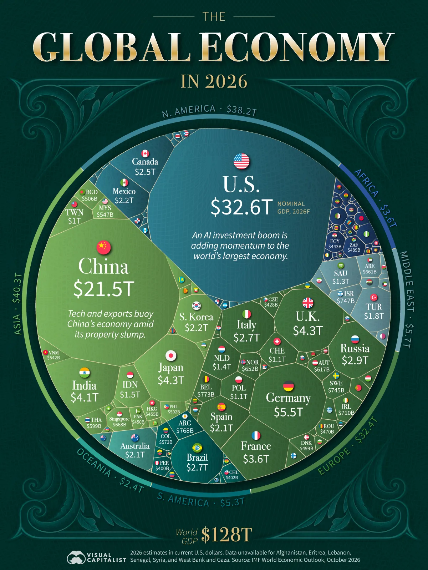
The global economy is projected to surpass $128 trillion by the end of 2026, with the United States and China alone accounting for more than 42 per cent of total output, according to the International Monetary Fund’s October 2026 World Economic Outlook.
The figures, measured in current U.S. dollars at market exchange rates, reveal a world economy increasingly defined by the dominance of two superpowers and a widening gap between those benefiting from the artificial intelligence investment boom and those left behind.
The Two Giants
The United States leads with a nominal GDP of $32.64 trillion, roughly a quarter of global output. China follows at $21.55 trillion—more than four times the size of Germany’s economy, the world’s third-largest at $5.47 trillion.
The concentration of economic power is stark. The U.S. economy alone is larger than the combined output of Germany, Japan, the United Kingdom, India, and France. Just four countries—the U.S., China, Germany, and Japan—contribute approximately half of global GDP.
The top ten is rounded out by the U.K. (4.06 trillion), France (2.86 trillion), Italy (2.65 trillion).
Africa’s Marginal Share
The visualization’s global picture underscores a persistent challenge for Africa. Despite nominal GDP rising from about $631.2 billion in 1990 to nearly $2.83 trillion in 2026, the continent still accounts for just over 2 per cent of global GDP . Africa’s share of global output has remained modest despite rapid population growth and decades of economic reforms.
Ghana is a notable mover within the African landscape. The IMF projects Ghana’s GDP at $128.64 billion in 2026, positioning the country to overtake Ethiopia as Africa’s eighth-largest economy . The Fund has also raised Ghana’s 2026 growth forecast to 5.7 per cent, up from an earlier projection of 4.6 per cent, driven by improved prospects in services and industry .
AI Investment Reshapes Growth Dynamics
The IMF’s broader outlook paints a picture of resilience amid divergence. Global growth is projected at 3.1 per cent in 2026, rising to 3.4 per cent in 2027, but the aggregate masks a growing divide between economies plugged into technology value chains and those that are not .
In the United States, the AI investment boom is generating demand for servers, software, data centres, and power infrastructure. The U.S. economy expanded at an inflation-adjusted annualised rate of 2.2 per cent in the second quarter of 2026, with household spending, investment, and exports all contributing.
China’s economy grew 4.6 per cent year-on-year in the first nine months of 2026, with high-tech manufacturing output rising 14.3 per cent alongside rapid increases in industrial robots and lithium-ion batteries. The country’s trade surplus in goods is on track to surpass $1 trillion again, supported by semiconductors and green technology exports. However, the property downturn continues to weigh on domestic demand, with real estate development investment falling more than 20 per cent in the first three quarters.
Inflation and Risks
The IMF expects global headline inflation to rise to 4.7 per cent in 2026, driven largely by higher energy and food prices, before easing to 4.1 per cent in 2027 . Energy-importing economies with limited integration into technology value chains face the most challenging outlook, with rising import costs, currency pressures, and declining real incomes.
Downside risks include intensified conflicts, a reassessment of AI expectations, renewed trade tensions, and fiscal vulnerabilities. Upside potential rests on stronger-than-expected AI investment momentum and productivity gains from artificial intelligence.
Methodology
The ranking uses nominal GDP, which measures annual economic output in current U.S. dollars converted at market exchange rates. This differs from purchasing power parity (PPP) measures, which adjust for cost-of-living differences and typically give greater weight to emerging economies. The IMF’s October 2026 estimates are based on information available through October 1, 2026 .