


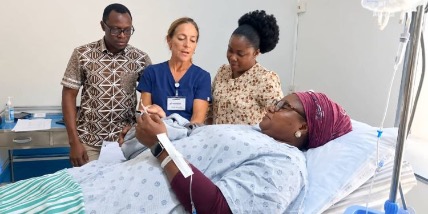
The Greater Accra Regional Hospital, Ridge, has launched an obstetric emergency simulation training programme for resident doctors and midwives, aimed at strengthening emergency response skills and contributing to national efforts to reduce maternal mortality.
The programme is being implemented in partnership with the IWK Medical Centre and Dalhousie University in Halifax, Canada, and is expected to run for three years with funding from International Development, Aid and Collaboration (IDAC) .
Training Focuses on Technical and Non-Technical Skills
In an interview with Channel One TV, Dr Kwaku Doffour-Dapaah, Head of Obstetrics and Gynaecology Residency Training and Maternal-Foetal Medicine Specialist at Ridge Hospital, said the training was designed to equip clinicians with both practical procedures and the so-called “soft skills” essential to managing emergencies.
“We are looking at using models and mannequins to train our doctors on how to work together in order to achieve the results we need them to achieve,” he said .
The practical component covers vaginal deliveries, breech births, and the management of complications during vaginal delivery. The non-technical component addresses effective communication with patients, leadership during emergencies, and the management of cardiac arrest before and after delivery .
“This is where the world is going, and it’s important our resident midwives and doctors learn them to enhance their management with patients,” Dr Doffour-Dapaah added .
Canadian Partners Emphasise Patient Safety
Maternal-Foetal Medicine Specialist at Dalhousie University, Dr Heather Scott, and Simulation Specialist and retired theatre nurse Michelle Murray, highlighted the programme’s role in helping healthcare professionals translate theoretical knowledge into practice.
“The simulation centre is ready to enhance the education of doctors and midwives. By practising intervention methods on modelled patients, it is a healthy way to learn. This is to increase patient safety and efficient outcomes,” they said .
Participants Report Tangible Benefits
Doctors and midwives who took part in the training described it as a valuable opportunity to rehearse emergency scenarios in a controlled environment.
Dr Erica Ntiamoah Mensah, a resident doctor in the Obstetrics and Gynaecology Department at Ridge Hospital, said the experience allowed her to practise handling high-pressure situations encountered in real clinical settings.
“It’s been a very good opportunity to be part of this simulation training. I have learnt a lot. I have been able to practise a lot of things that we see in real life, especially in a very pressured environment,” she said .
Sylvia Agyapong Boateng, a midwife at the hospital’s Maternity Intensive Care Unit, said the training improved participants’ ability to identify complications, intervene promptly, and work as a team.
“Through the simulation programme, we learnt how to use life-modelled patients to know more about their conditions, identify complications, prompt interventions and enhance teamwork to improve maternal care. It was very educational and promising,” she said .
Dr Amponsa Dadzie, an Obstetrician and Gynaecologist at Ridge Hospital, said the exercises clarified the distinct responsibilities of different healthcare professionals during emergencies.
“We simulated a patient who is bleeding, and as a team, we have learnt how to manage that. As doctors, midwives and nurses, everyone knows their roles and how to execute them efficiently to save that patient and increase positive maternal outcomes,” he said .
National Context: Maternal Mortality Remains a Pressing Challenge
The initiative comes as Ghana continues to grapple with maternal mortality levels well above international targets. According to the National Development Planning Commission, Ghana’s maternal mortality ratio stands at approximately 301 deaths per 100,000 live births—significantly higher than the Sustainable Development Goal target of 70 .
Institutional maternal mortality data show that the Greater Accra Region recorded a ratio of 175.74 per 100,000 live births in 2025, up from 163.71 in 2021, placing the region among the highest-burden areas in the country .
The leading clinical causes of maternal deaths in Ghana include haemorrhage, hypertensive disorders, unsafe abortion complications, and sepsis—most of which occur around the time of delivery and are largely preventable with timely and effective emergency response .
The government has launched the Presidential Initiative on Maternal Health Emergency Response (PRIMER), a five-year intervention aimed at accelerating the reduction of preventable maternal deaths through political leadership, accountability, and sustainable domestic financing .
Existing Partnership History
The collaboration between Ridge Hospital and Canadian institutions is not new. Dalhousie University’s Department of Obstetrics and Gynaecology has partnered with Ghanaian hospitals since at least 2015, including prior simulation-based research and training exchanges involving Ghanaian residents at the IWK Health Centre in Halifax . Dr Doffour-Dapaah himself completed an eight-week elective at the IWK focused on maternal-foetal medicine and simulation-based research, according to a 2022 departmental newsletter .
The three-year simulation programme at Ridge Hospital represents an expansion of that partnership into structured, on-site training for the broader clinical team.
Correction: An earlier version of this story stated that the three-year partnership funding came from “International Development, Aid and Collaboration (IDAC).” The source material provided by the user contains this spelling; readers should note that the exact name of the funding organisation may require verification with Ridge Hospital.