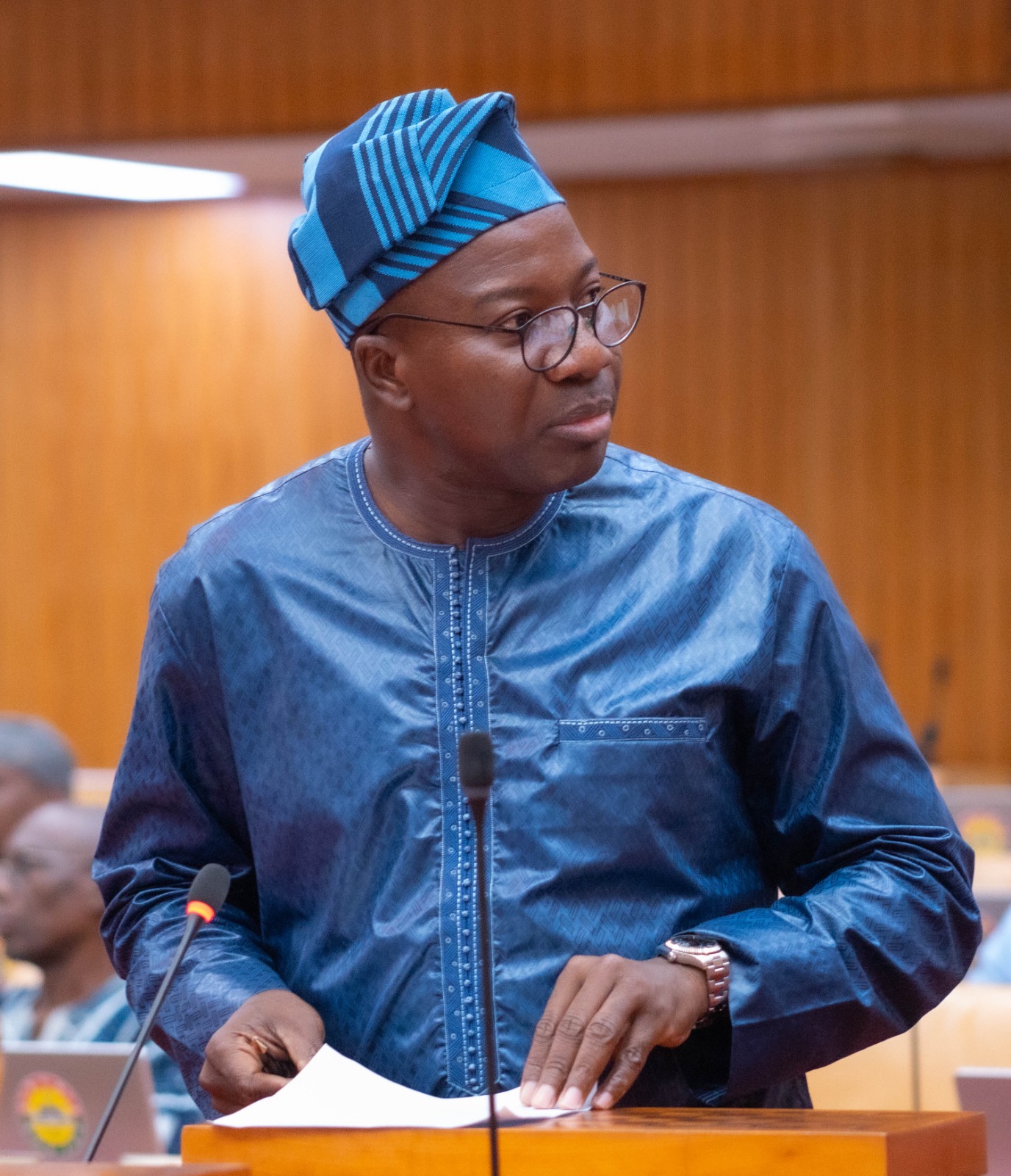
In the entire 2024 fiscal year, Ghana’s 261 District Assemblies received a combined total of just GH¢390 million from the District Assemblies Common Fund (DACF). In 2025 alone, that figure exploded to GH¢5 billion — a more than twelve-fold increase. And in the first two quarters of 2026, GH¢4.1 billion has already been disbursed, bringing the total under the current administration to GH¢9.1 billion across six quarters.
The figures were disclosed by the Minister for Local Government, Chieftaincy and Religious Affairs, Hon. Mahama Ayariga, at the Government Accountability Series held at the Jubilee House on Monday, October 5, 2026.
The revelation offers a stark contrast between the final full year of the previous New Patriotic Party (NPP) administration and the first eighteen months of the National Democratic Congress (NDC) government led by President John Dramani Mahama — and it underscores what the Minister describes as a deliberate shift in how the state funds local development.
A District-Level Snapshot
The national figures only tell part of the story. In the Abura Asebu Kwamankese District in the Central Region, for instance, the Assembly received just GH¢280,000 by way of Common Fund in 2024. In 2025, the same Assembly received GH¢14 million — a fifty-fold increase.
The contrast is even more dramatic when placed against the district’s own budget projections. In earlier fiscal years, the Abura Asebu Kwamankese Assembly had projected DACF receipts of GH¢6,026,474.49 for the year, yet actual disbursements amounted to GH¢3,961,897.10 — a 34.2 percent shortfall. The 2024 figure of GH¢280,000 represents a fraction of even that underperformance.
For a district of over 100,000 residents, the impact of receiving less than GH¢300,000 in a full year is severe: stalled classroom blocks, uncompleted CHPS compounds, deferred borehole drilling, and abandoned drainage works. The 2024 Annual Action Plan for the Abura Asebu Kwamankese District contained 98 projects and programmes. The vast majority would have been left unfunded.
Why 2024 Was So Bad
The GH¢390 million disbursed in 2024 — sometimes cited as GH¢362 million in official figures — was not the amount Parliament had approved for the fund. Parliament had allocated substantially more, but the releases never came.
The Minority in Parliament subsequently claimed that the Mahama government owed the DACF approximately GH¢7.33 billion in arrears covering the 2024 period, based on actual government revenue reported in the National Accounts. The DACF Administrator, Michael Harry Yamson, confirmed to Parliament that the arrears stood at GH¢7.33 billion.
During the previous administration, the DACF Administrator had attributed the chronic delays to the Presidency. Naa Torshie Addo, then Administrator of the Fund, told party delegates in November 2025 that former President Nana Akufo-Addo and Vice President Dr. Mahamudu Bawumia “refused to release the common funds.”
The DACF is set by law at 7.5 percent of government revenues, but releases are not automatic — they are tied to actual revenue mobilisation and treasury releases. The Fund does not generate money on its own, and transfers have historically not been timely.
Audit reports from 2024 paint a grim picture. The non-release of Common Fund allocations, auditors warned, “may negatively impact on the various development projects and programmes aimed to improve the quality of life for citizens at the local level.” In the Ahafo Region, the total allocations to six Assemblies for 2024 amounted to GH¢10,391,296.63 — but out of this amount, only a fraction was released.
The 2025 Turnaround
Under the current administration, the picture changed dramatically. In 2025, GH¢5 billion was disbursed to the Assemblies, distributed across four quarters:
· First Quarter: GH¢790,372,058.40
· Second Quarter: GH¢1,464,983,309.60
· Third Quarter: GH¢1,188,921,640.80
· Fourth Quarter: GH¢1,592,706,391.20
Then in the first two quarters of 2026, a further GH¢4.1 billion was released, bringing the cumulative total to GH¢9.1 billion across six quarters. This represented all six quarters of DACF allocations owed since the government assumed office, as Minister Ayariga explained at the Government Accountability Series.
“The Ministry has facilitated the transfer of total amount of GH¢9.1 billion, six quarters of the DACF, to MMDAs for the provision of socio-economic infrastructure and improved living conditions for the Ghanaian people,” Ayariga said.
He said the increased transfers were consistent with the principle of “Funds Follow Functions” — the idea that local authorities can only effectively perform their responsibilities if adequate resources are made available to them.
Strings Attached
The increased funding came with specific development obligations attached. Minister Ayariga, in an earlier April 2026 Accountability Series briefing, explained that timely releases were tied to measurable deliverables. Each district was expected to construct at least two Community-based Health Planning and Services (CHPS) compounds, three classroom blocks, and ten boreholes. Additionally, 25 percent of the Common Fund was earmarked for the development of 24-hour economy model markets.
The government also committed to ensuring that not less than 88 percent of DACF resources were disbursed directly to MMDAs.
The 2026 Outlook
Parliament has approved a DACF allocation of GH¢8,769,707,900 for 2026, representing an increase of 16.78 percent over the GH¢7.51 billion allocated for 2025. Of this, between 80 and 90 percent will be transferred directly to MMDAs to support decentralised development.
The 2026 formula was presented to Parliament by then-Majority Leader Mahama Ayariga and seconded by Minority Leader Alexander Afenyo-Markin.
President Mahama has also directed Metropolitan, Municipal and District Chief Executives (MMDCEs) to organise corresponding accountability engagements in their jurisdictions twice a year, following the model of the Presidential Accountability Series. The directive, signed by Minister Ayariga on October 2, 2026, applies to regions where the President has already held his own accountability engagements.
Who is Mahama Ayariga?
Mahama Ayariga is a lawyer and seasoned politician who has served as the Member of Parliament for Bawku Central since 2005. He holds a law degree from the University of Ghana and has studied political science and decentralisation, according to former MP Inusah Fuseini, who described him as “an effective parliamentarian.”
Ayariga served as Deputy Minister of Trade and Industry, Minister of Youth and Sports, and later as Majority Leader in Parliament before President Mahama appointed him Minister for Local Government, Chieftaincy and Religious Affairs on August 7, 2026. He was sworn in on August 29, 2026. He left Parliament to take up the ministerial role, describing it as “a personal choice” and expressing conviction that he could make a greater impact on Ghana’s local governance system.
He has since moved swiftly on his decentralisation agenda, announcing plans to make live radio coverage of MMDA meetings mandatory, and calling for a paradigm shift away from over-reliance on development partners towards locally sustainable funding mechanisms.
The Government Accountability Series
The platform on which Ayariga made the disclosure is itself an innovation of the current administration. The Government Accountability Series (GAS) was launched in July 2025 as a forum where Ministers of State take turns to brief the public on their ministries’ performance and respond to questions.
“Unlike in the past, the public and the media no longer have to rely solely on the Right to Information Act, wait for Parliamentary Question Time, or depend on the occasional briefings by Chief Directors,” wrote Franklin Cudjoe of IMANI Africa in a November 2025 assessment of the initiative. “GAS has reframed accountability as a direct encounter: duty bearers versus the people.”
What It Means
For Ghana’s 261 District Assemblies, the numbers disclosed by Ayariga represent a fundamental shift in the resourcing of local governance. The 2024 figure of GH¢390 million — spread across 261 Assemblies — averaged just over GH¢1.4 million per district for an entire year. By contrast, the 2025 disbursement of GH¢5 billion averaged approximately GH¢19 million per district.
Whether the increased funding translates into tangible improvements in the lives of ordinary Ghanaians — in the form of functioning clinics, habitable classrooms, clean water, and passable roads — will be the measure by which the government’s decentralisation agenda is ultimately judged. But as a statement of intent, the contrast between 2024 and 2025 could hardly be starker.
The Ministry has signalled that it will conduct a review, alongside the Ministry of Finance, to ascertain the level of compliance with the utilisation guidelines and identify areas that need revision. For the Assemblies — and the communities they serve — the question now is not whether the money will arrive, but what it will build.
Source: Government Accountability Series, Jubilee House, October 5, 2026. Additional reporting from MyJoyOnline, Citi Newsroom, GhanaWeb, Graphic Online, Ghana News Agency, and the District Assemblies Common Fund Secretariat.