



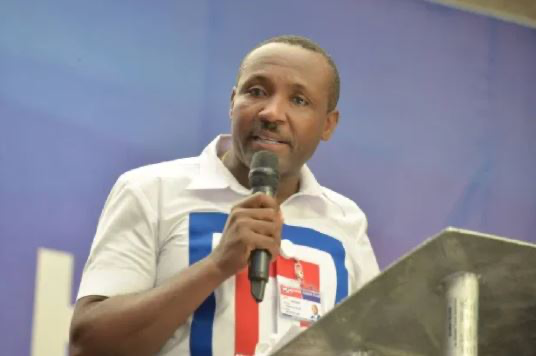
John Boadu has been elected National Chairman of the New Patriotic Party (NPP), staging a dramatic political comeback nearly four years after losing his position as the party’s chief scribe.
The 56-year-old former General Secretary secured 2,888 votes — approximately 48.5 percent of the total votes cast — to defeat former Energy Minister Boakye Kyeremateng Agyarko, who polled 2,408 votes, and former National Chairman Paul Afoko, who received 790 votes. Former Greater Accra Regional Chairman Sammy Crabbe trailed with 41 votes.
The election, held at the Baba Yara Sports Stadium in Kumasi, stretched from Saturday, October 3, into the early hours of Sunday, October 4, drawing over 7,000 delegates from all 16 regions of Ghana. The Ashanti Region recorded the highest delegate presence with 1,122, followed by Greater Accra with 773 and the Eastern Region with 732.
A Last-Minute Alliance
Boadu’s path to victory was bolstered by a last-minute alliance with Sammy Crabbe. In a signed statement dated Saturday, October 3, Crabbe announced he was joining forces with Boadu, saying the two were “jointly announcing an alliance for unity of purpose.” Crabbe clarified, however, that his move did not amount to a formal withdrawal from the race.
Pre-election surveys had pointed to a Boadu victory. A poll released on September 29, 2026, placed him at 46.5 percent support among respondents, with Agyarko at 24.8 percent and Afoko at 9.1 percent. A separate survey by Africa Policy Lens, based on 1,627 completed records from eligible delegates, similarly projected a Boadu win.
From Grassroots to National Leadership
Boadu’s victory represents the culmination of more than three decades of service within the NPP’s structures. He is widely regarded as the only party officer to have served in executive positions at every level — from polling station chairman through constituency secretary, Greater Accra Regional Research and Information Officer, National Youth Treasurer, National Youth Organiser, Deputy National Communications Director, National Organiser, and ultimately General Secretary.
His involvement in the party predates the establishment of the Fourth Republic. As a young activist, he participated in the Danquah-Busia Club alongside figures such as former President John Agyekum Kufuor and Nana Akufo-Addo. He served as a polling agent in the 1996 elections and as a trainer of trainers in the Greater Accra and Volta Regions ahead of the 2000 general elections.
Boadu served as Acting General Secretary in 2015 following the suspension of then General Secretary Kwabena Agyei Agyepong, and was subsequently elected substantive General Secretary in 2018. He held the position until 2022, when he lost his re-election bid to Justin Frimpong Kodua at the party’s National Delegates Conference at the Accra Sports Stadium.
Beyond party politics, Boadu holds a Bachelor of Science degree in Accounting from the University of Ghana Business School. He has served as a board member of the Tema Oil Refinery and GOIL Company Limited, and was appointed Acting Director-General of the State Interests and Governance Authority (SIGA) by President Akufo-Addo in December 2023, where he served until the end of the administration.
Decisive Victory for Continuity
Boadu’s win came on a night of significant decisions for the NPP. Incumbent General Secretary Justin Frimpong Kodua retained his position with a commanding 4,486 votes — the highest tally recorded by any candidate in the 2026 national executive elections — defeating Sylvester Tetteh (1,340 votes), Eugene Boakye Antwi (162 votes) and Dr. Charles Dwamena (129 votes).
In the vice chairmanship race, Kojo Fosu Boadu secured the First Vice Chairman position with 3,116 votes, followed by Henry Nana Boakye as Second Vice Chairman with 3,061 votes and Nana Akomea as Third Vice Chairman with 2,987 votes. Thirteen candidates contested the three positions.
Alfred Kwadwo Thompson won the National Treasurer position with 2,243 votes, while Daniel Nii Kwartei Titus-Glover clinched the National Organiser role with 2,964 votes. Mavis Hawa Koomson was elected National Women’s Organiser with 783 votes, defeating Safia Mohammed (429 votes). Abanga Fuseini Yakubu won the National Youth Organiser position with 1,550 votes, and Mohammed Ali Suraj emerged as National Nasara Organiser with 372 votes. Dennis Edward Miracles Aboagye was elected National Communications Director unopposed.
Constitutional Reforms and Party Leadership
Before the elections, delegates approved all 14 proposed amendments to the party’s constitution. Among the key changes was a provision reversing a clause introduced at the party’s January 31, 2026 conference that had designated the National Chairman as the party’s leader. Under the newly approved amendment, the NPP’s presidential candidate — Dr. Mahamudu Bawumia — becomes the party leader upon election as flagbearer.
The congress was held in two parts, with delegates first considering and approving the constitutional amendments before proceeding to vote for national officers.
A Party Seeking Renewal
Boadu’s election comes at a critical juncture for the NPP, which is working to reorganise after its defeat in the 2024 general elections. Former President John Dramani Mahama of the National Democratic Congress won the presidency with 56.55 percent of the vote, while NPP flagbearer Dr. Mahamudu Bawumia secured 41.61 percent — one of the heaviest defeats for the party in decades.
Speaking after his election, Boadu called on party members to unite around efforts to rebuild the organisation. “Our task is to build a renewed NPP,” he said, describing the outcome not simply as a victory for particular candidates but as a mandate carrying significant responsibility.
He extended an invitation to aspirants who lost their respective contests, urging them not to withdraw from party activities. “The experience, ideas and expertise demonstrated during the campaign belonged to the NPP and should be harnessed for its development,” he said.
Boadu also called on the newly elected executives to work together and ensure that differences arising from the elections do not undermine party unity. He said the party must now transform the energy generated by the elections into practical work at the national, regional and constituency levels.
Background: A Party at a Crossroads
The NPP was founded on June 2, 1992, and traces its roots to the Danquah-Busia tradition, one of Ghana’s oldest political movements. A centre-right liberal-conservative party, it has been one of the two dominant political forces in Ghana since the return to multi-party democracy, with John Kufuor serving as President from 2001 to 2009 and Nana Akufo-Addo from 2017 to 2025.
The party’s 2024 defeat — attributed in part to internal divisions, governance challenges and weak communication — prompted an extensive internal review. An 11-member committee chaired by former Speaker of Parliament Prof. Mike Oquaye investigated the causes of the loss. The party subsequently amended its constitution to address structural weaknesses, including expanding the electoral college to give former executives voting rights and introducing reforms aimed at strengthening internal democracy.
Boadu campaigned on a platform of experience and party-wide institutional knowledge, positioning himself as the candidate best equipped to lead the party’s reorganisation. His campaign emphasised election-management experience, including his role in the 2016 general elections when, as National Organiser, he simultaneously served as Acting General Secretary and Director of National Campaign Operations during a period of internal leadership crisis. The NPP went on to win the 2016 election by more than one million votes and gained 55 parliamentary seats from the then-governing NDC.
In the lead-up to the congress, the Takoradi Technical University chapter of the Patriotic Intellectuals Ghana endorsed Boadu, citing his approximately three decades of service within the party and the institutional knowledge required to lead at the national level.
The Road Ahead
The new leadership — anchored by Boadu as National Chairman and Frimpong Kodua as General Secretary — faces the collective task of unifying and re-energising the party’s base ahead of the 2028 general elections. The NPP is seeking to reclaim power after its 2024 defeat, with the new executives expected to lead preparations at the national, regional and constituency levels.
Boadu has stressed that the party’s focus must be on victory in 2028. Speaking during his campaign, he outlined plans to strengthen the party’s electoral machinery, including rapid results collation systems, nationwide training for polling agents and voter verification processes.
“The task ahead is enormous, but with unity of purpose, the NPP can rise again,” Boadu said.


