



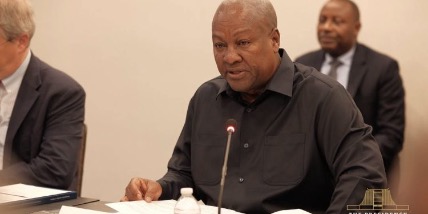
President John Dramani Mahama has called on countries of the Global South to strengthen domestic capacity, build effective institutions and secure sustainable financing as they navigate mounting debt pressures and a rapidly shifting international development landscape.
Speaking at a Presidential Roundtable organised by the Open Society Foundation in New York on Monday, September 21, on the sidelines of the 81st United Nations General Assembly, Mahama said the priority must be to create jobs, improve public services, build infrastructure and expand opportunities, particularly for young people.
“When I speak about sovereignty in this context, I am speaking about the capacity to act,” Mahama told the gathering of presidents and chief executives of major global foundations. “A country needs to be able to set its priorities, negotiate effectively, mobilise resources, and follow through on its decisions”.
The roundtable brought together leaders from some of the world’s most influential philanthropic institutions, including the Gates Foundation, Ford Foundation, Open Society Foundations, Rockefeller Foundation, Hilton Foundation, Hewlett Packard, Humanity United, Anglo American, Chandler Foundation and UBS Optimus. The discussions focused on sustainable development, financing and strengthening institutions across the Global South.
A Shifting Global Order
Mahama’s address comes at a moment of profound disruption in the international development architecture. The President told the roundtable that the global order is facing severe disruption, with countries across the Global South contending with debt burdens that have reached crisis levels.
The numbers paint a stark picture. External debt across Africa has reached approximately US88.7 billion in 2026, further constraining fiscal space and crowding out essential investments in infrastructure and social services. Across climate-vulnerable nations, debt costs consume resources at 25 times the rate of climate action spending. Annual debt servicing in affected regions consumes approximately 4.4 per cent of GDP, with net financial flows to the Global South turning negative for the first time in decades.
In the face of these pressures, Mahama argued that the continent’s leaders must immediately strengthen the institutions, financing capabilities and delivery systems needed to achieve Africa’s long-term strategic ambitions.
“In all the disruption and chaos are born new ideas and partnerships,” Mahama said. “This is when we must create jobs for our people, improve public services, build infrastructure, and expand opportunity, especially for our young people. For countries such as Ghana, the question is how we strengthen our ability to pursue those priorities with greater confidence and continuity, whatever the changes taking place around us”.
The Accra Reset: From Design to Execution
The President used the platform to advance the Accra Reset, the development framework he has championed as African Union Champion for African Financial Institutions. The initiative challenges the long-standing development model under which countries were expected to take ownership of programmes while key decisions remained in the hands of external partners.
“The Accra Reset asks what countries need to act with urgency in a changing world, and what a more balanced relationship with international partners could look like,” Mahama told the roundtable. “It aims to reverse this dependency by establishing sovereign delivery systems that bypass traditional implementation bottlenecks”.
The Accra Reset was formally launched during the 80th UN General Assembly in September 2025 as a framework for re-engineering global development institutions, anchored in sovereignty, workability and shared value. In April 2026, President Mahama announced a high-level panel of the Accra Reset tasked with reforming the global health architecture and governance system, and a Geneva Health Dialogue followed in May. On Monday, September 21, 2026, Mahama hosted a high-level Accra Reset event under the theme “Full Circle: Making Global Development Work Again,” bringing together world leaders to discuss the future of global development cooperation with particular focus on Africa and the Global South.
Domestic Resource Mobilisation: The Path to Sovereignty
Central to Mahama’s vision is domestic resource mobilisation. Africa’s domestic capital pools now exceed US2.5 trillion in banking assets and US$1.7 trillion held by pension funds. The President has argued that this capital must be deployed strategically to finance transformative development projects while reducing dependence on external financing.
“We need stronger coordination across government, better preparation of programs and projects, greater domestic resource mobilisation, sound financial management, and institutions that can demonstrate clear results,” Mahama said. “We must also leverage capabilities outside government, including civil society, business, academia, and local communities. We must carry our share of the responsibility if we want greater room to lead”.
The emphasis on domestic capacity is already shaping policy in Ghana. The government has embarked on an ambitious revenue mobilisation drive under its IMF-supported reform programme, targeting a cumulative increase in non-oil revenue of 0.8 per cent of GDP. The Ghana Revenue Authority is conducting a comprehensive review of income tax legislation, while the Ministry of Finance is working to operationalise the Value for Money Office and extend GIFMIS coverage to all spending units to strengthen budget execution and expenditure controls.
Ghana’s macroeconomic trajectory has provided tailwinds for the broader agenda. Under the IMF-supported programme, inflation has declined sharply, international reserves have been rebuilt, and the debt-to-GDP ratio has been reduced from 92.7 per cent in 2022 to 59.1 per cent in 2025. The IMF has noted that Ghana has improved its revenue mobilisation efforts compared to other sub-Saharan African countries, though gaps remain to reach the frontier.
A New Compact with International Partners
Mahama used the roundtable to call for a fundamental shift in how international partners and philanthropic organisations engage with developing countries. He urged foundations to move from short-term programmes to long-term capability building.
“Can international cooperation do more to build national capability and work through local systems when they meet required standards? Can we reduce unnecessary duplication while protecting accountability?” Mahama asked.
Highlighting the vital role of philanthropy in health, education, governance and research across Africa, the President called on foundations to use their unique flexibility to fund public goods and institutional capacity where commercial finance cannot.
“Foundations have room to operate differently because they can support institutional capability, early programme development, public goods and social priorities,” he said. “Where an approach proves successful, the next step should be its adoption into public systems, local delivery institutions, and long-term financing models”.
The message resonates with a broader shift underway in African development policy. At the African Development Bank’s 2026 Annual Meetings in Brazzaville, policymakers urged African countries to mobilise domestic resources and attract long-term capital amid mounting global shocks, declining aid flows and rising debt burdens. The African Forum of Deposit Funds welcomed the New African Financial Architecture for Development initiative, aimed at mobilising Africa’s vast domestic resources and channelling them toward financing transformative development projects while reducing dependence on external financing.
Institutional Strength as the Foundation
Throughout his remarks, Mahama returned to the theme of institutions capable of delivering measurable results. He acknowledged that Ghana still has significant progress to make to exercise full ownership over its development trajectory.
“Where an approach proves successful, the next step should be its adoption into public systems, local delivery institutions, and long-term financing models,” he said.
The President’s emphasis on institutional capability echoes his engagement with the Open Society Foundation earlier in the week. On Sunday, September 20, Mahama met with Alex Soros, Chairman and Founder of the Open Society Foundations, to discuss partnerships and support for ECOWAS integration efforts. That meeting set the stage for Monday’s roundtable.
In September 2025, President Mahama designated the Millennium Development Authority (MiDA) as the government’s primary focal institution for coordinating philanthropic and grant-based partnerships, specifically including collaboration with global philanthropic giants such as the Open Society Foundation, the Bill and Melinda Gates Foundation, and the Mastercard Foundation.
The Road Ahead
The Presidential Roundtable forms part of a busy schedule of engagements for Mahama at UNGA81, where he will also host a high-level event on reparatory justice on Wednesday, September 23, and deliver Ghana’s official statement at the main General Debate on Thursday, September 24.
For the Global South, the stakes could not be higher. With net financial flows turning negative and debt burdens consuming resources that should be directed toward health, education and infrastructure, the call for domestic resource mobilisation and institutional strengthening has moved from aspiration to imperative.
As Mahama told the roundtable: “We must carry our share of the responsibility if we want greater room to lead”. Whether the international community — governments, foundations and multilateral institutions alike — will match that commitment with a genuine shift toward long-term capability building remains the central question.


