



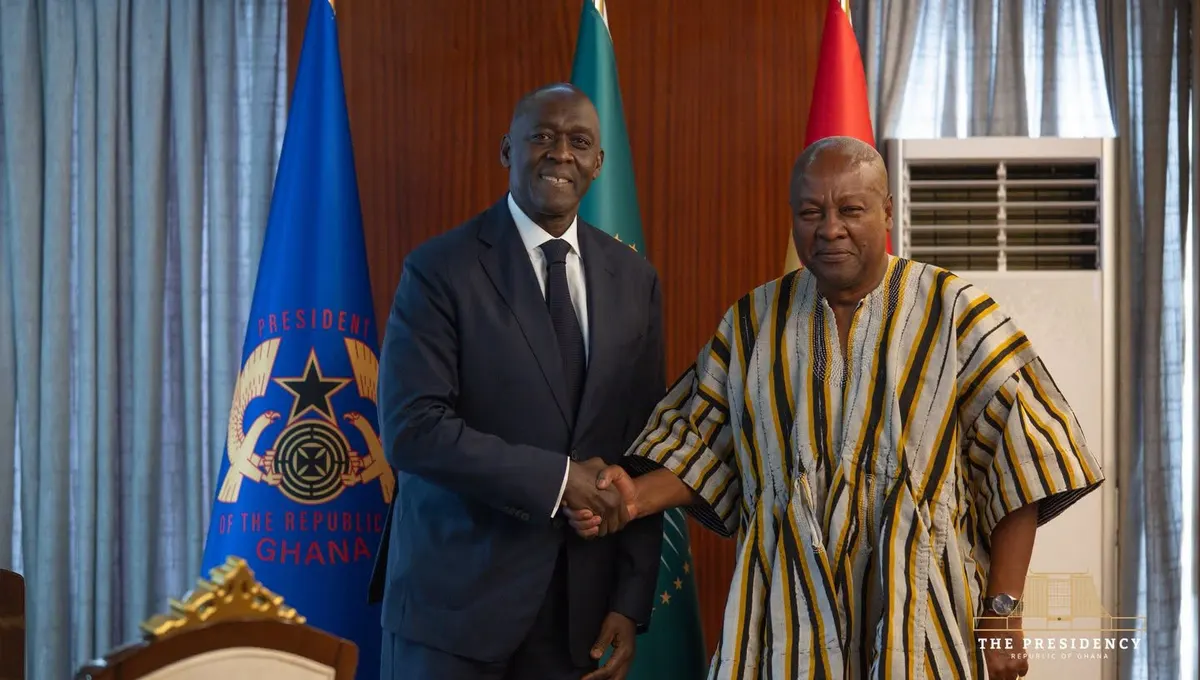
The International Finance Corporation (IFC) will invest $100 million in the Volta Ecological Zone and an additional $50 million to construct a railway linking Ghana’s Volta River corridor to landlocked Sahelian countries, Managing Director Makhtar Diop announced on the sidelines of the 81st United Nations General Assembly in New York on Monday, September 21, 2026.
The announcement follows a meeting between Diop and Finance Minister Dr Cassiel Ato Forson in Accra on September 16, and comes as Ghana positions itself as a destination for private capital after completing a sweeping economic reform programme.
Bridging the Seven-Kilometre Gap
At the centre of the railway investment is a seemingly modest but strategically vital piece of infrastructure: a seven-kilometre missing rail link connecting Ghana’s existing rail network to the Volta River.
President John Dramani Mahama personally raised the issue with Diop during their meeting in Accra, explaining that completing the link would allow goods to be transported via the river towards northern Ghana and onwards into Burkina Faso.
“I went to see President Mahama. He said we have both railway which go into the Volta River, but there is missing seven kilometres to be able to take it to the shore of the river, and we need to take those goods to take them through the river to the north of Ghana so that we are connecting Burkina,” Diop recounted. “He told me there are some private investors there who are ready to do that. I went to meet one of them; they were one of our clients, and at the beginning we came, and we were discussing a project, we were just signing 100 million dollars, and we are about to sign another 50 million dollar project”.
The full logistics corridor, estimated at $200 million in total financing, would involve extending the railway the remaining seven kilometres, connecting electricity to the river shore, dredging sections of the Volta Lake, and deploying three boats to move goods northward. President Mahama publicly disclosed the $200 million financing commitment during a closing ceremony at the Accra Reset high-level event: “He broke the good news to me just when he sat next to me: $200 million of financing to open the logistics corridor to the Sahelian states”.
The project aligns with Ghana’s broader plan to develop a 1,012-kilometre railway from Takoradi Port to Hamile in the Upper West Region, a corridor designed to channel cargo destined for landlocked Sahelian economies such as Burkina Faso, Mali and Niger through Ghanaian territory. The government has said it expects to complete the full rail corridor within three to five years and has already begun discussions with Burkina Faso on connecting Ouagadougou to the Ghanaian port city of Tema.
Ghana’s Economic Turnaround Draws IFC Confidence
Diop’s visit to Accra, his first to Ghana as IFC Managing Director, was marked by strong praise for the country’s economic trajectory under an IMF-supported reform programme.
“We have seen that in the last few years, Ghana has turned the tide. They’ve been able to do a solid adjustment, but also to put in place measures that will structurally, hopefully, help Ghana not to go back into a situation where the debt is a problem, and inflation is affecting the economy,” Diop said following his meeting with Minister Forson.
The macroeconomic data bears this out. Under Ghana’s Extended Credit Facility arrangement with the IMF, inflation has declined rapidly, international reserves have been rebuilt, and confidence in the cedi has improved. Fiscal performance strengthened markedly, with the primary surplus overperforming the programme target in 2025 while the public debt ratio declined sharply. Inflation fell from double-digit levels to 5.3 per cent by June 2026, and international reserves reached $11.9 billion by the end of 2025, covering four months of imports. The debt-to-GDP ratio was reduced from 92.7 per cent in 2022 to 59.1 per cent in 2025, supported by a $2.8 billion debt restructuring deal.
IMF Managing Director Kristalina Georgieva’s staff assessment in May 2026 noted that the programme had delivered “substantial stabilization gains,” with growth exceeding expectations in 2025 on the back of broad-based activity and historically high gold export receipts.
Diop said these gains had created the conditions for deeper private-sector engagement. The IFC’s own portfolio in Ghana tells a story of rapidly escalating commitment: the corporation has financed and mobilised approximately $505 million in private investments in Ghana in the 2026 fiscal year to date, building on $410 million delivered in the fiscal year ending 2025. Overall commitments reached $670 million through the IFC’s own account and mobilisation in FY2026, up sharply from just $61 million in FY2021.
The corporation currently has a $1.2 billion pipeline of potential investments in Ghana and plans to do more.
Energy, Infrastructure, Agriculture — and Jobs
The discussions between Diop and Minister Forson focused on attracting greater domestic and international private capital, with the Finance Minister presenting a list of priority sectors.
“At the top of it are energy, infrastructure, agriculture, and the ability to create jobs in this country,” Diop said.
This focus is already reflected in the IFC’s recent commitments. In September 2026, the IFC provided $39.5 million to LMI Holdings as the second tranche of a $100 million facility to support a 100-megawatt-peak solar project at the Dawa Industrial Zone, following a first tranche of $21 million committed in 2025. The IFC also announced long-term financing for a 170-room Hampton by Hilton hotel near Accra International Airport, expected to create 990 direct and indirect jobs and targeting EDGE Advanced green building certification.
“Ghana’s progress in reducing debt and easing inflationary pressures has created better conditions for attracting both local and foreign investors,” Diop said.
Poultry Sector Identified for Import Substitution
Diop singled out Ghana’s poultry industry as a sector with significant potential for import substitution, noting that the country continues to import large volumes of poultry products.
“There is no reason why Ghana cannot on this side be self-sufficient,” he said.
The numbers underscore the scale of the opportunity. Ghana currently spends between $300 million and $400 million annually on poultry imports, according to the Ministry of Food and Agriculture. Domestic production would need to increase tenfold to displace frozen chicken imports, which currently supply up to 95 per cent of the market. The government has committed to attaining full self-sufficiency in poultry production within three years through its Feed Ghana Programme and the Nkoko Nketenkete backyard poultry initiative.
Diop said the IFC’s approach is to help indigenise production in selected sectors — including pharmaceuticals, energy and agriculture — to create jobs and make economies more resilient to external shocks.
Local Champions Initiative to Strengthen Domestic Businesses
Diop also highlighted the IFC’s Local Champions Initiative, a programme designed to strengthen businesses and investors from Africa to expand investment within the continent. The initiative provides a standardised package of technical assistance and tailored support to small and medium-sized enterprises in fragile contexts, helping them align with IFC investment requirements.
The programme has been rolled out in Côte d’Ivoire, Senegal, Cameroon and Burkina Faso, among other markets, with the goal of deepening investment pipelines and supporting structured growth pathways for local businesses.
“We are leaving the meeting with new ideas of things that we can do better to attract private sector in Ghana from outside but also to support the domestic private sector,” Diop said.
A Bet on Regional Trade
The timing of the IFC’s investment package reflects a broader continental push to deepen intra-African trade. At the same UNGA side event where Diop spoke, AfCFTA Secretary-General Wamkele Mene noted that intra-African trade stood at between 15 and 20 per cent of the continent’s total trade, citing $220 billion in recorded intra-African trade in 2024.
For Ghana, the Volta corridor project represents a strategic bet: that by positioning itself as the logistics gateway to the Sahel — a region of over 100 million people — the country can parlay its hard-won macroeconomic stability into a durable role as West Africa’s trade and transit hub. The IFC’s willingness to commit $150 million before the ink has even dried on the second agreement suggests that at least one major investor believes the bet is sound.


