



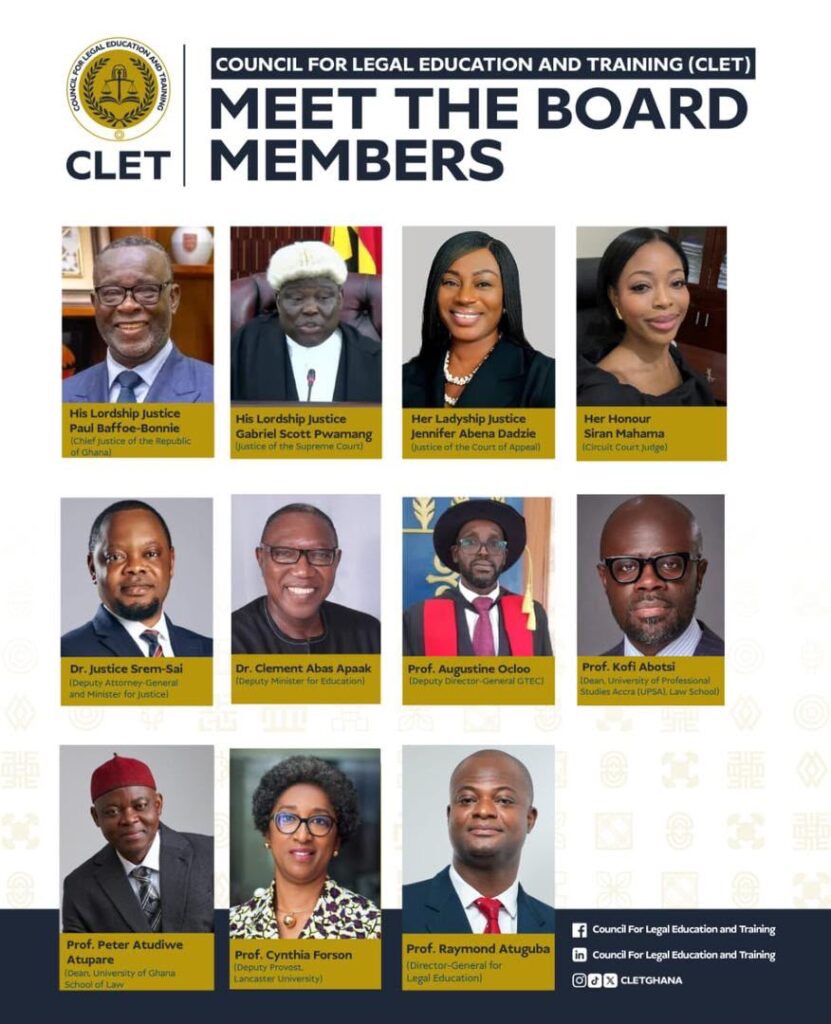
Chief Justice Paul Baffoe-Bonnie has been named Chairman of the newly constituted 11-member Board of the Council for Legal Education and Training (CLET), in a development expected to give fresh momentum to ongoing reforms in Ghana’s legal education and professional training.
The board, unveiled on Monday, brings together senior members of the judiciary, government officials, and academics from some of Ghana’s leading law schools and tertiary institutions.
Its membership is:
· Justice Paul Baffoe-Bonnie – Chief Justice of the Republic of Ghana (Chairman)
· Justice Gabriel Scott Pwamang – Justice of the Supreme Court
· Justice Jennifer Abena Dadzie – Justice of the Court of Appeal
· Her Honour Siran Mahama – Circuit Court Judge
· Dr Justice Srem-Sai – Deputy Attorney-General and Minister for Justice
· Dr Clement Abas Apaak – Deputy Minister for Education
· Prof Augustine Ocloo – Deputy Director-General, Ghana Tertiary Education Commission (GTEC)
· Prof Kofi Abotsi – Dean, University of Professional Studies, Accra (UPSA) Law School
· Prof Peter Atudiwe Atupare – Dean, University of Ghana School of Law
· Prof Cynthia Forson – Deputy Provost, Lancaster University
· Prof Raymond Atuguba – Director-General for Legal Education
The composition gives the board broad representation from the judiciary, the ministries responsible for justice and education, the tertiary education regulator, and major law faculties.
CLET is responsible for overseeing aspects of legal education and professional legal training in Ghana, including the administration of the Ghana School of Law and related regulatory functions.
The new board comes as Ghana continues efforts to implement reforms in legal education following the passage of the Legal Education Act. The legislation created CLET to assume responsibility for regulating legal education and training, separating those functions from the broader responsibilities traditionally exercised by the General Legal Council.
The reforms are aimed at expanding access to legal education, preserving professional standards, improving institutional coordination, modernising curricula, and strengthening public confidence in legal training.
For decades, the old system, managed solely by the General Legal Council, was criticised for being too restrictive, with limited admission spaces at the Ghana School of Law leaving many qualified graduates unable to complete their professional training each year.
Chief Justice Baffoe-Bonnie has been a vocal advocate for the reforms. At a recent colloquium, he said the Act sought to bridge Ghana’s legal education legacy with future demands.
“Let us preserve standards with integrity. Let us expand opportunity with fairness. And let us build a legal profession that truly reflects the constitutional ideals of our Republic, one that produces lawyers worthy of defending justice, liberty and the rule of law,” he said.
The Ghana Bar Association has previously called for the operationalisation of the legislation and the establishment of its governing structures, arguing that this would provide the institutional framework needed to advance reforms in legal education.
With the board now in place, attention will turn to implementing the new framework. Key tasks ahead include accrediting universities to run professional legal training programmes and overseeing the transition to the new system.
The inclusion of senior judicial officers, government representatives and academics on the new board is expected to provide oversight across the different areas involved in legal education and professional training.
The board will now be expected to take forward its responsibilities under the legal education framework, including providing oversight for the development and administration of legal education and training in Ghana.


