



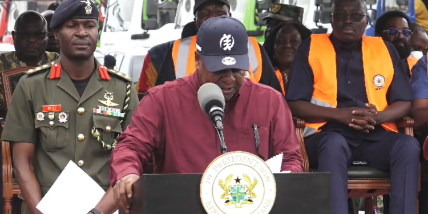
President John Dramani Mahama has announced plans to develop engineered landfill facilities in all 16 regional capitals as part of a comprehensive effort to improve waste management across Ghana.
Speaking at the launch of the National Emergency Waste Evacuation Exercise, President Mahama said the plan would create a functional waste management system from households to final disposal. It includes providing waste bins to households, constructing additional waste transfer and transit stations, and supplying equipment to support waste collection and management.
The government will also increase the number of recycling plants to handle the growing volume of waste and expand landfill capacity in Greater Accra and Kumasi.
“We’ll increase the number of recycling plants to handle the waste that is generated across the country,” the President said. “The plan also provides for the expansion of landfill capacity in the greater Kumasi area and the development of engineered landfill facilities in all 16 regional capitals.”
The announcement comes amid a worsening sanitation crisis. Greater Accra relies on only two major landfill sites. The Kpone landfill is full and expected to close within months, while the Adepa landfill near Nsawam is more than 40 kilometres from Accra, reducing collection efficiency. In Kumasi, the Oti landfill receives between 2,000 and 2,500 tonnes of waste daily — far beyond its capacity — and could close within three months.
Ghana generates about 4,400 tonnes of solid waste daily, or roughly 1.6 million tonnes annually, with an average collection rate of 80 per cent. Poor waste management costs the country more than GH¢6.2 billion each year through flooding, health costs and environmental damage. Only about 9.5 per cent of collected plastic waste is recycled, despite annual plastic waste generation of about 840,000 tonnes.
President Mahama said the programme would go beyond evacuation. “As we implement it, we must also strengthen waste separation, recycling and material recovery to reduce the volume of waste requiring final disposal and create opportunities for enterprise and employment,” he said.
He called on assemblies, traditional authorities, private operators and citizens to support the programme. “The good news is that the Minister for Finance has committed to supporting this programme,” he said.
Finance Minister Dr Cassiel Ato Forson has committed to funding the emergency exercise through the District Assemblies Common Fund. The operation will use District Road Improvement Programme equipment already paid for by the government, with funding mainly for fuel, per diem and maintenance. The Ministry of Roads and Highways has secured more than 200 tipper trucks from road contractors. Much of the work will be done at night to reduce traffic disruption.
The National Emergency Waste Evacuation Exercise, which began on September 17, is a joint operation involving the Ministry of Local Government, Chieftaincy and Religious Affairs, the Ghana Armed Forces and the District Road Improvement Programme. It aims to clear the decades-old refuse heap at Agbogbloshie. The Finance Minister has also said provision will be made in the 2027 budget for modern landfill sites in major cities.
President Mahama warned that clean-up exercises would fail if indiscriminate dumping continued. “If we clean Agbogbloshie today and you go and dump there tomorrow, we have done nothing. Cleanliness must become a way of life,” he said.
He added: “For too long, we have lived with this shame in the middle of our capital. Today, we say enough is enough. Accra must breathe again. Jamestown must live again.”
Officials say the reclaimed land at Agbogbloshie is expected to be repurposed for an industrial park. With Ghana’s annual waste generation projected to rise from 4.75 million tonnes in 2025 to 8.55 million tonnes by 2050, the success of the plan will depend on sustained financing, coordination and a shift in public attitudes toward waste disposal.


