



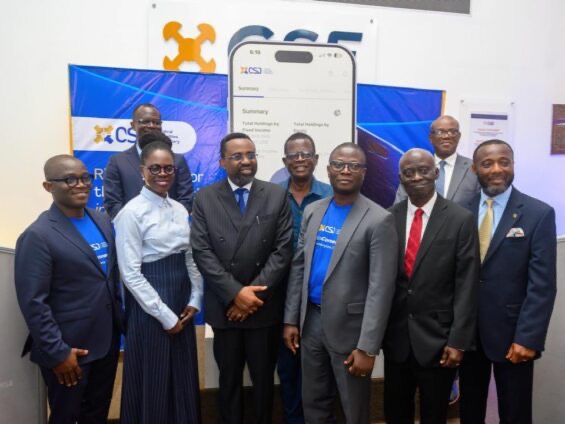
The Governor of the Bank of Ghana, Dr. Johnson Asiama, has moved to calm nerves over the cedi’s recent slide, revealing that a measured depreciation of the local currency can be a deliberate policy tool rather than a loss of control. Speaking to capital market stakeholders on the floor of the Ghana Stock Exchange, Dr. Asiama assured businesses that the foreign exchange market remains firmly within the central bank’s grip.
The Currency Picture
The cedi has come under renewed pressure in recent weeks, depreciating to around GH¢12 per dollar at some forex bureaus, while the central bank’s interbank selling rate stood at approximately GH¢11.59 as of Thursday. The pressure has been largely driven by strong corporate and offshore foreign exchange demand — particularly for import payments, coupon repatriation, and an early year-end inventory build-up — against relatively tight interbank supply. The cedi’s year-to-date depreciation now stands at nearly 9.0%.
A Deliberate Strategy
Governor Asiama, however, framed the movement as part of a broader economic management strategy.
“Managing an economy, someday things might be challenging, but it doesn’t mean we lose control. Sometimes it’s okay to allow the system to adjust; sometimes it’s deliberate policy to allow the cedi to depreciate a little bit. It’s all within the strategy, so when you see those little movements, don’t be alarmed at all; we have it all under control,” he assured.
The Governor’s remarks come against a backdrop of significant macroeconomic improvements. Since assuming office in February 2025, Dr. Asiama has led efforts to consolidate monetary stability and enhance regulatory discipline. Under his leadership, the Bank of Ghana has overseen fourteen consecutive months of declining headline inflation, with February 2026 inflation falling to 3.3% — its lowest level since the rebasing of the price index in 2021, compared to 23.1% a year earlier. The central bank’s Monetary Policy Committee has cut the policy rate by a cumulative 400 basis points in 2026, bringing it to 14.0% in March before pausing in May.
External buffers have also strengthened, with Gross International Reserves reaching US9.4 billion, while the trade surplus rose to US$3.7 billion for January–February 2026, driven by favourable gold prices and lower non-oil imports.
Capital Market Momentum
The Governor’s address on the floor of the GSE underscored the central bank’s focus on capital market development as a pillar of economic growth. The Ghana Stock Exchange has emerged as one of the best-performing equity markets globally in 2026, with the GSE Composite Index delivering a return of 63.4%, placing Ghana second only to South Korea. The equities market is now valued at GHS 263 billion, complemented by a fixed income market worth GHS 253 billion.
Dr. Asiama charged managers of the various sectors to ensure confidence in the system. He also appealed to the Central Securities Depository to ensure transparent information on investment portfolios is provided to the investing public, believing the move will make the capital market more attractive to potential and young investors.
The CSD has already taken steps in this direction. In August 2026, it launched the Investor Connect portal, a digital platform allowing retail investors to open CSD accounts and buy securities online — including Treasury bills, bonds, and equities — using a Ghana Card or passport for onboarding. The platform provides real-time access to securities holdings and transaction history, a move the CSD describes as essential to achieving greater financial inclusion.
Outlook
While the cedi is expected to retain a mild depreciation bias in the coming weeks, GoldBod’s planned US$700 million forex supply to commercial banks, together with continued Bank of Ghana support and reserve accumulation, should improve market liquidity and help contain the risk of a disorderly adjustment. Databank Research also projects that the central bank could cut the policy rate by a further 150 basis points to 12.5% at its September 2026 meeting, aligning with continued moderation in inflation toward the Bank of Ghana’s medium-term target range of 8% ±2%.
For businesses and investors, the Governor’s message was clear: the cedi’s movements are within the strategy, and the central bank retains the tools to keep the economy on track.


