



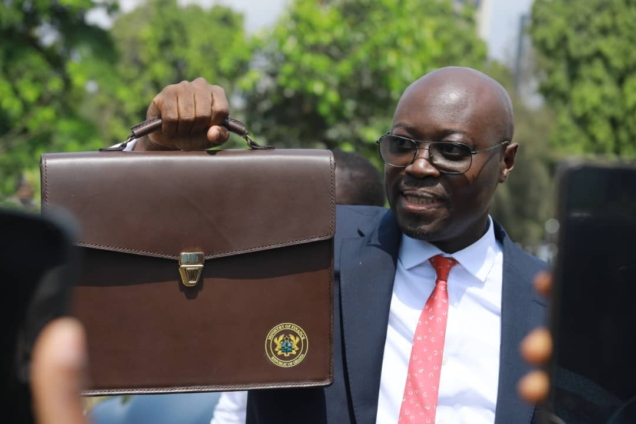
Finance Minister Dr Cassiel Ato Forson has hinted that the 2027 Budget will be presented to Parliament in the first week of November 2026, setting the stage for what he describes as a major pivot from economic stabilisation to job creation and large-scale infrastructure investment.
In an interview with Kumasi-based Ahenfie FM, Dr Ato Forson said the budget will outline plans for major infrastructure projects, policy initiatives to create jobs, and fresh incentives to support businesses seeking to expand into new areas .
From Stabilisation to Transformation
According to the Finance Minister, the government has spent its first two years focused on stabilising the economy and is now preparing to push ahead with measures to stimulate stronger growth.
“Stabilisation was never the destination. It was the price of entry. Ghana has paid that price. What comes next is the work that changes lives at scale—the work of transformation,” Dr Forson said during a previous engagement on the New Economy programme .
The 2027 Budget will contain the full details of the government’s “New Economy” transformational programme, which President John Dramani Mahama has said will involve about US$10 billion in investment in key sectors of the economy .
Consultations Underway
Preparations for the 2027 Budget are already well advanced. The Finance Minister has begun engagements with key ministries, departments and agencies ahead of budget hearings and the rollout of the new economic programme .
Dr Forson has already met with the Ministry of Trade, Agribusiness and Industry to discuss the New Economy agenda . The National Development Planning Commission (NDPC) has also been tasked with tracking and assessing the implementation of the programme as it is rolled out .
Some ministries have already appeared before the Finance Ministry to justify their proposed expenditure for 2027, as government works to identify priority sectors and investment opportunities .
The Legal Deadline
The planned November presentation falls within Ghana’s public financial management framework. Section 21(3) of the Public Financial Management Act, 2016 (Act 921) requires the Finance Minister to present the budget for the following financial year no later than November 15 .
The timeline is intended to give Parliament sufficient time to consider and approve the necessary expenditure before the start of the new financial year on January 1, 2027, ensuring government has the required legal authority to undertake expenditure from the beginning of the year .
Economic Context
The 2027 Budget comes at a pivotal moment for Ghana’s economy. The country expanded by 6.4% in the first quarter of 2026, extending the stronger growth recorded over the past year . Full-year GDP growth reached 6% in 2025, the highest since 2019 .
Ghana is also preparing to exit its three-year IMF Extended Credit Facility programme in August 2026, following its sixth and final review . A report by the France-Ghana Chamber of Commerce and Industry projected real GDP growth between 4.6% and 5.9% by year-end 2026, noting that the economy is entering “a period of stabilisation, recovery and private sector opportunity” .
The services sector remains the primary engine of recovery, expanding by roughly 7.6% in recent quarters, while agriculture plays a stabilising role through agro-processing and value addition .
Jobs at the Centre
The government’s employment ambitions are substantial. Three major investment programmes are expected to account for about 95% of the 800,000 jobs targeted under the 2026 Budget .
The Big Push infrastructure programme alone is projected to generate about 490,000 jobs from road and related infrastructure projects, accounting for approximately 61% of the headline target. The Integrated Oil Palm Development Programme is expected to contribute more than 250,000 jobs, while three garment factories are projected to provide over 20,000 direct positions .
The Accra-Kumasi Expressway, a flagship infrastructure project, is expected to create about 30,000 direct and indirect jobs during construction .
Dr Ato Forson said the 2027 Budget will build on these initiatives with fresh incentives designed to support business expansion and encourage ventures into new areas .
“Through the New Economy agenda that we will unveil, we will build an economy that does not merely withstand shocks but creates jobs, generates wealth and grows on the strength of what Ghana produces,” he said .


