



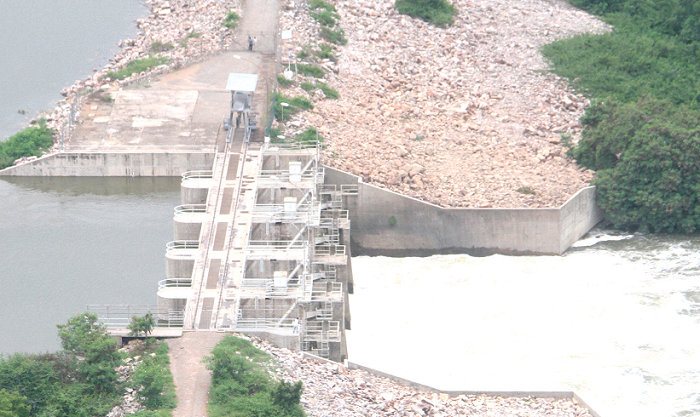
The Ghana Water Limited (GWL) has clarified that the water observed flowing from the Weija Dam on Tuesday, September 8, was merely a trial run of the spill gates, with the actual spillage officially commencing at 6 am on Wednesday, September 9.
The clarification comes after reports emerged suggesting that the spillage had already begun, contrary to the company’s earlier communication that the exercise would start on Wednesday .
Why the trial was necessary
Stanley Martey, Head of Public Relations and Communications at GWL, explained during an interview on Joy FM’s Super Morning Show that Tuesday’s exercise was purely technical—a test to confirm the functionality of the dam’s hydraulic spill gates before full deployment .
“Yesterday [Tuesday] we tested the gates, and everything, but actual spillage started this morning,” Mr Martey said.
He emphasised that testing the gates ahead of the actual spillage is essential because hydraulic gates can sometimes become stuck. A malfunction at a critical moment could create serious problems, making trial runs a necessary precaution .
“Before anything, you need to do some trials, something like that, so that you are sure that any time you want to open a gate, you want the gate to be functioning effectively,” he explained.
Why another spillage this year?
The current spillage marks the second time in 2026 that the Weija Dam has been opened, following a previous exercise in May. However, Mr Martey stressed that there is no rule limiting the dam to a single spillage annually .
“The frequency depends largely on the amount of water flowing into the dam from upstream,” he said. “There are certain years that we spill throughout the year. There are years where we spill throughout the following year” .
The decision to spill hinges on three key factors: the volume of inflows from upstream, the current water level in the dam, and expected rainfall patterns .
Heavy rainfall upstream of the Densu River and its tributaries has pushed the water level to 45.2 feet, edging closer to the 46-foot threshold that triggers precautionary action .
Operating protocols explained
Mr Martey provided insight into the dam’s operating procedures, noting that the maximum operating level for the Weija Dam is approximately 47 feet .
However, GWL does not wait until the dam reaches its maximum capacity before initiating spillage. During the major rainy season, the company begins releasing water at 44 feet because of the likelihood of increased rainfall and inflows .
The approach differs during the minor rainy season. According to Mr Martey, this is why GWL waited until the water level reached about 45 feet before commencing the current spillage .
In May 2026, the situation was more critical—the water level had risen above 48 feet, prompting the company to open all spill gates to protect the dam’s structural integrity .
What happens if the dam collapses?
Mr Martey warned that allowing water levels to rise beyond safe limits could have catastrophic consequences. Excessive pressure could weaken the dam’s structure and potentially cause it to fail .
“There’ll be a point in time when the levels will go beyond a certain manageable level, and so we have to open the steel gate for the excess water to flow,” he explained .
He noted that a collapse could not only claim lives and destroy property but would also disrupt water supply to large parts of western Accra. “Until the dam is rebuilt, Ghana Water wouldn’t be able to extract water for treatment,” he stated .
Communities at risk
The Weija Dam supplies approximately 80 percent of the potable water for Accra and its surrounding environs, making its maintenance a critical national priority .
Authorities have identified several communities likely to be affected by the spillage, including Tetegu, Oblogo, Pambros Salt, Lower McCarthy Hill, Lower Weija, Bojo Beach, Adankope (Ada Kopey), and surrounding areas .
The National Disaster Management Organisation (NADMO) has assured residents that the current situation remains under control. According to Emmanuel Essel, Weija-Gbawe Municipal NADMO Director, the exercise involves opening only one of the dam’s five gates by six inches to regulate water levels .
“So far, there’s no cause for alarm,” Mr Essel said, confirming that authorities have contingency measures in place should the volume of water increase .
Lessons from past experiences
The caution being exercised is informed by painful memories of past spillage-related disasters. In 2022, when the Weija Dam was spilled, residents in Weija, Tetegu, Oblogo, and surrounding communities watched floodwater invade their homes and businesses. Some were stranded, while others were forced to use canoes to move around .
The May 2026 spillage similarly caused flooding, with vehicles and homes submerged in affected communities, forcing thousands to flee their homes .
GWL has therefore directed residents to evacuate immediately from unauthorised settlements along the river course to prevent loss of life and property . The company has also urged NADMO, district assemblies, traditional authorities, and resident associations to activate precautionary measures and prepare for possible evacuations .
Looking ahead
The controlled spillage may continue for days, weeks, or even months, depending on rainfall patterns and inflow volumes . The Ghana Meteorological Agency has forecast continued torrential rains upstream, which could prolong the exercise .
GWL has reiterated its commitment to safeguarding the dam infrastructure while ensuring public safety, appealing to residents to cooperate with emergency directives and advisories issued by state institutions .


