



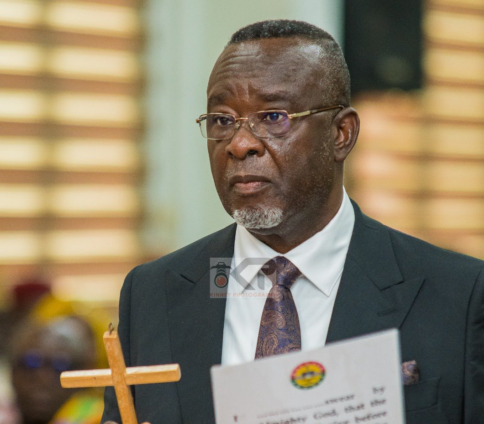
The Ghana Catholic Bishops’ Conference has dismissed demands by the opposition New Patriotic Party (NPP) for the resignation of Chief Justice Paul Baffoe-Bonnie, describing the calls as disproportionate to the controversy generated by his recent remarks on the performance of state institutions.
In a statement issued on Sunday, September 6, the Conference acknowledged that some of the Chief Justice’s comments during visits to the Social Security and National Insurance Trust (SSNIT) and the Minerals Income Investment Fund (MIIF) could raise legitimate concerns about the appearance of judicial impartiality, but maintained that the available evidence does not establish partisanship or a compromised Judiciary.
The Genesis of the Controversy
The controversy stems from comments made by Justice Baffoe-Bonnie on September 2, 2026, during an outreach engagement with members of the Council for Legal Education and Training at SSNIT and MIIF.
At MIIF, the Chief Justice praised the institution’s current management while questioning what had been achieved over the “past eight years.” He was quoted as saying, “I must congratulate you. I mean, you have done marvellously well. Sometimes, when we hear about the things that you have done and the things that some organisations are doing now, we wonder. Some of us keep wondering what we really have been doing in the past eight years”.
Similarly, during his visit to SSNIT, he referenced past attempts to dispose of prized assets such as the Labadi Beach Hotel, remarking, “you wonder how Ghana could have sunk so low”.
These remarks were widely interpreted within Ghana’s politically charged environment as a comparison between the administration of President John Dramani Mahama and that of his predecessor, Nana Akufo-Addo.
The Bishops’ Assessment
The Bishops noted that while there was nothing improper about the Chief Justice visiting public institutions to assess their operations or commend improvements, the political character his remarks acquired was a matter of concern.
“In our national context, such a phrase is readily heard as a comparison between the present administration and its predecessor,” the Conference stated. “What may have started as a straightforward assessment of institutional performance thus took on, at least in appearance, the character of a partisan judgment”.
The Conference referenced concerns raised by the Ghana Centre for Democratic Development (CDD-Ghana), which had warned that the comments could create an impression of political endorsement and weaken public confidence in judicial impartiality.
Judicial Service Clarification
The Bishops said they had taken note of the Judicial Service’s clarification issued on September 4, in which the Chief Justice acknowledged the mixed public reaction to his observations and stated that they were made “in good faith” and were not intended to undermine judicial independence.
The statement, signed by Judicial Secretary Musah Ahmed, reaffirmed the Chief Justice’s commitment to “upholding the integrity and independence of the Judiciary, and the promotion of justice and equality before the law”.
“We receive that clarification in good faith,” the Bishops said.
A Question of Perception
The Conference nevertheless stressed that the episode raises important questions about judicial ethics and public trust, particularly given the unique position the Chief Justice occupies.
“The Chief Justice is not an ordinary public commentator,” the Bishops said, noting that courts could be called upon to determine disputes involving the government, political parties and public institutions. “Judicial independence is not only a matter of actual impartiality; it also depends on the visible, unmistakable appearance of impartiality”.
An Uncertain Judicial Landscape
The controversy unfolds against a backdrop of declining public confidence in Ghana’s Judiciary. According to the 2024 Afrobarometer Round 10 survey cited by CDD-Ghana, only 35% of Ghanaians expressed trust in the courts, a 21-percentage-point decline from 2012 levels. The survey also found that 62% of citizens believed judicial decisions were routinely influenced by powerful interests.
NPP Renews Calls
The NPP has been unwavering in its position. Deputy General Secretary Haruna Mohammed renewed the party’s demand on September 5, insisting that the Chief Justice must either retract and apologise or step down. “The Chief Justice must retract and apologise or resign and be sent to the Council of State,” he said on TV3’s The KeyPoints.
Mohammed argued that the remarks made the Chief Justice appear to be acting as a political communicator for the governing National Democratic Congress (NDC). “If you did not see the video, you will think that he is an NDC communicator who has been tasked to go and praise the President,” he stated.
Differing Perspectives
Legal and academic commentators have also weighed in. Dr Joshua Ebuntie Zaato, a Senior Lecturer at the University of Ghana’s Department of Political Science, criticised the Chief Justice’s comments as an “attempt to cannibalise the judicial arm of government and now to add it to the Executive”. He argued that restricting the assessment of SSNIT to the previous eight years amounted to cherry-picking and partisanship.
Conversely, NDC Deputy General Secretary Mustapha Gbande dismissed the resignation calls, asserting that the Chief Justice’s observations did not make him a supporter of the governing party. “The Chief Justice is not NDC. I don’t know him to be NDC. The NDC does not need a Chief Justice to comment for us,” he said on Joy FM.
A Measured Conclusion
The Bishops concluded that the controversy does not amount to evidence that the Chief Justice is partisan or that the Judiciary has been compromised. “Such conclusions would go well beyond the evidence available to us, and calls for his resignation on this basis alone strike us as disproportionate to the offence,” they said.
The Conference suggested that the Chief Justice could have commended the achievements of SSNIT and MIIF on their own merits without comparing the records of successive administrations. It also appealed to both the governing party and the opposition to exercise restraint.
“The governing party ought not to treat criticism of the Chief Justice as an attack on its own record, nor should the opposition treat his remarks as proof that the courts have been captured,” the statement said.
The Bishops urged all public office holders to uphold the same standard of restraint, regardless of which party is in government, to protect confidence in Ghana’s democratic and judicial institutions.


